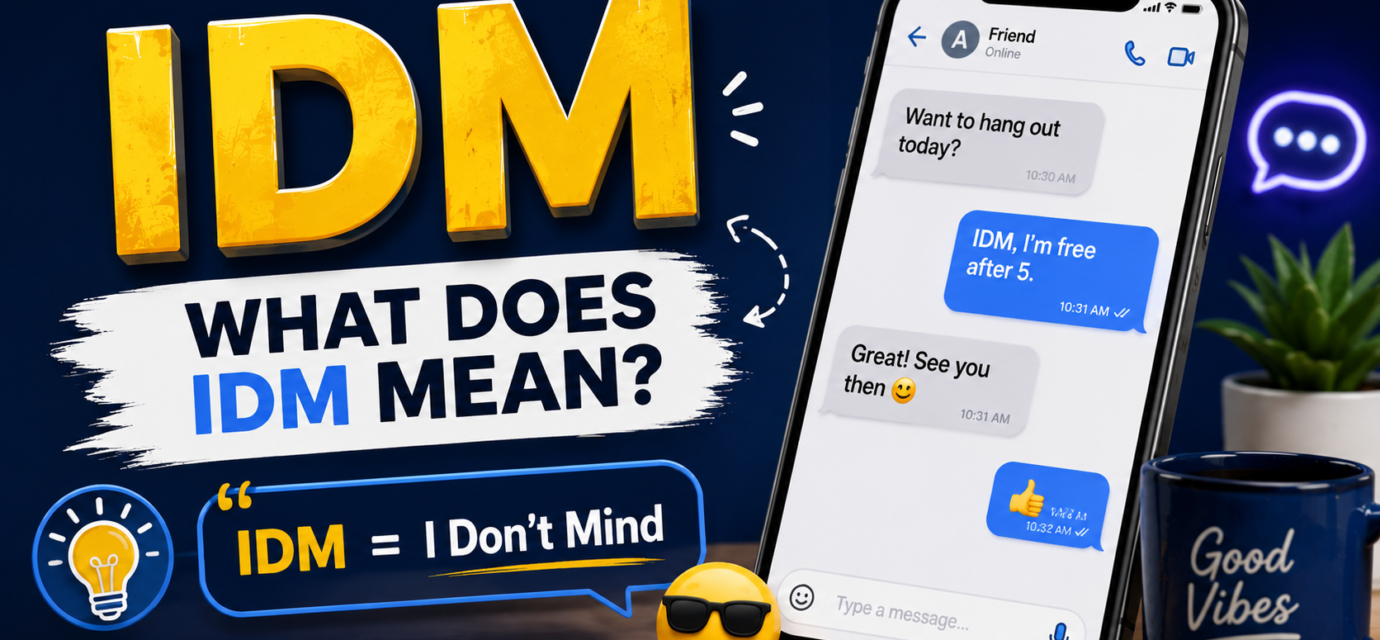

If you have seen “IDM” in a text message, Instagram DM, Snapchat chat, TikTok comment, or WhatsApp conversation, you may wonder what does idm mean?
In texting, IDM usually means “I Don’t Mind.” It is used when someone wants to say that they are okay with something, have no objection, or are comfortable with a choice.
For example:
“Do you want pizza or burgers?”
“IDM, you choose.”
This means:
“I don’t mind. You choose.”
IDM is generally casual and neutral. It can make a response sound relaxed because the person is leaving the decision open to someone else.
IDM – Quick Meaning
What Does IDM Stand For?
IDM = I Don’t Mind
People use IDM to show that they are flexible about a situation or choice.
It can communicate:
- Agreement
- Flexibility
- Indifference
- Acceptance
- Lack of preference
- A relaxed attitude
Examples of IDM in Text
“IDM where we go.”
Meaning: “I don’t mind where we go.”
“IDM if you come later.”
Meaning: “I don’t mind if you come later.”
“IDM, whatever works for you 😊”
This sounds friendly and flexible.
Origin & Background
IDM developed as part of the broader culture of internet abbreviations and mobile texting.
As online communication became faster, people began shortening common phrases to save time and effort.
Expressions such as IDK, IMO, TTYL, BRB, LOL, and WYD became common examples of this communication style.
“I Don’t Mind” is naturally easy to shorten to IDM because the first letters capture the phrase clearly.
Social Media Influence
IDM can appear across many digital platforms, including:
- Snapchat
- TikTok
- Facebook Messenger
- SMS
- Discord
- Online gaming chats
It is especially useful when someone is giving another person freedom to choose.
How the Meaning Evolved
The basic meaning of IDM has remained stable.
The tone, however, can change according to context.
“IDM 😊”
can sound friendly.
“IDM.”
may sound neutral or indifferent.
“IDM, you decide.”
usually sounds relaxed and cooperative.
Real-Life Conversations
WhatsApp Conversation
Person A:
“Should we eat at the new restaurant?”
Person B:
“IDM. You pick.”
Person A:
“Okay, let’s go there!”
Here, IDM means the person has no preference.
Instagram DM
Person A:
“Do you want me to send the pictures tonight or tomorrow?”
Person B:
“IDM, whenever you’re free 😊”
The response communicates flexibility.
TikTok Comment
Person A:
“Which version should I post?”
Person B:
“IDM, both look good!”
Here, IDM means the commenter has no strong preference.
Text Message
Person A:
“Can we meet at 5 instead of 4?”
Person B:
“IDM. 5 works for me.”
The person is agreeing to the change.
Emotional & Psychological Meaning
IDM may look simple, but it can communicate several subtle attitudes.
Flexibility
The person may genuinely be comfortable with different options.
“IDM, you choose.”
This gives the other person control over the decision.
Acceptance
IDM can show that someone accepts a suggestion without resistance.
“IDM if we stay home tonight.”
Lack of Preference
Sometimes IDM simply means the person does not particularly care which option is chosen.
Keeping Things Easy
People may use IDM to avoid unnecessary disagreement.
Instead of debating every small decision, they allow the other person to choose.
A Real-Life Communication Scenario
Imagine a friend asks:
“Do you want to meet at the café or the park?”
You do not have a preference, so you reply:
“IDM, you choose 😊”
It keeps the conversation easy and lets your friend decide.
Usage in Different Contexts
Social Media
IDM can be used in comments, DMs, and group chats when someone has no strong preference.
Friends and Relationships
Friends may use IDM when deciding where to eat, what movie to watch, or when to meet.
“IDM what we watch. You pick.”
Partners may also use it when they genuinely do not mind a particular choice.
Work and Professional Settings
IDM is usually too informal for formal workplace communication.
Instead of:
“IDM.”
you could say:
“Either option works for me.”
or:
“I’m comfortable with either choice.”
Casual vs. Serious Tone
“IDM 😊” sounds relaxed and friendly.
“IDM, you choose.” sounds cooperative.
“IDM.” may sound neutral or slightly indifferent depending on the conversation.
When NOT to Use IDM
Formal Emails
Avoid IDM in formal emails and official correspondence.
Academic Writing
Texting abbreviations do not belong in essays, research papers, or formal assignments.
Important Decisions
If a decision genuinely matters to you, saying IDM when you actually have a preference may create confusion.
Emotional Conversations
IDM can sound dismissive if someone is discussing an important emotional issue.
For example:
“Do you care if I leave?”
Replying only:
“IDM.”
could sound cold or uncaring.
When You Need to Explain Your Preference
If there is a clear reason why one option is better, explain it instead of simply saying IDM.
Common Misunderstandings
IDM Usually Means “I Don’t Mind”
In texting, this is the most common interpretation.
IDM Does Not Always Mean “I Don’t Care”
There is an important difference.
“I don’t mind” often means either choice is acceptable.
“I don’t care” can sound much more dismissive.
IDM Can Sound Different Depending on Punctuation
Compare:
“IDM 😊”
with:
“IDM.”
The first feels warmer.
The second may feel more detached.
IDM Does Not Always Mean Agreement
Someone may say IDM because they have no objection, but they may not necessarily be excited about the choice.
IDM vs. Similar Slang
| Expression | Meaning | Typical Tone |
|---|---|---|
| IDM | I Don’t Mind | Neutral/flexible |
| IDC | I Don’t Care | Casual/possibly dismissive |
| IDK | I Don’t Know | Uncertain |
| WTV | Whatever | Casual |
| UP2U | Up to You | Flexible |
| YW | You’re Welcome | Friendly |
| NVM | Never Mind | Casual |
| K | Okay | Very casual |
Key Insight
IDM means “I Don’t Mind” and usually shows flexibility rather than strong indifference. It tells the other person that several choices are acceptable.
Variations and Types
1. IDM
The standard abbreviation for “I Don’t Mind.”
2. idm
The lowercase form is common in casual texting.
3. IDM, You Choose
Shows that the sender is happy to let the other person decide.
4. IDM Either Way
Means both options are acceptable.
5. IDM At All
Emphasizes that something is not a problem.
6. IDM If You Come
Shows acceptance of someone’s arrival or participation.
7. IDM Where We Go
Communicates that the location does not matter.
8. IDM What We Watch
Used when choosing a movie, show, or video.
9. IDM 😊
The emoji makes the message sound warmer.
10. IDM, Whatever Works
Shows flexibility while encouraging the other person to choose what is convenient.
How to Respond When Someone Uses IDM
Your response can depend on whether you need them to make a decision.
Casual Replies
“Okay, you choose 😂”
“Cool, let’s do that!”
“Sounds good!”
Funny Replies
“So I get all the decision-making power? 😂”
“Don’t blame me if you hate my choice 😭”
Mature Replies
“Okay, I’ll go with the first option.”
“Great, I’ll make the decision then.”
Respectful Replies
“Thanks. I’ll choose what works best for both of us.”
“Okay, I’ll let you know what I decide.”
Regional & Cultural Usage
Western Culture
IDM is understandable in casual English-language texting and online conversations.
It is especially useful when someone wants to express flexibility.
Asian Culture
English texting abbreviations such as IDM are widely encountered among younger internet users across Asia.
They may appear alongside local languages.
Middle Eastern Culture
English-speaking social media users may also use IDM in casual messages.
Its meaning generally remains “I Don’t Mind.”
Global Internet Usage
IDM is relatively easy to understand because the abbreviation follows the first letters of a common English phrase.
Still, not every internet user will recognize it immediately.
Gen Z vs. Millennials
Both Gen Z and Millennials may recognize IDM.
Younger users may prefer phrases such as “idc,” “up to you,” “whatever works,” or simply “you choose.”
Is IDM Safe for Kids?
Yes. IDM is harmless texting slang.
It simply means “I Don’t Mind.”
There is no offensive or inappropriate meaning in its standard texting use.
Children may encounter IDM in ordinary conversations with friends, classmates, or family members.
FAQs
What does IDM mean in texting?
IDM usually means “I Don’t Mind.” It is used when someone has no strong preference or is comfortable with a particular choice.
What does IDM mean on Snapchat?
On Snapchat, IDM generally means “I Don’t Mind.” Someone may use it when they are comfortable with a suggestion or decision.
What does IDM mean on Instagram?
On Instagram, IDM usually means “I Don’t Mind.” It can appear in DMs, comments, or casual conversations.
Is IDM the same as IDC?
No. IDM means “I Don’t Mind,” while IDC means “I Don’t Care.” IDM often sounds more accepting, while IDC can sometimes sound dismissive.
What does “IDM, you choose” mean?
It means “I don’t mind, so you can choose.” The person is giving the other person freedom to make the decision.
Is IDM rude?
Usually not. IDM is generally neutral or friendly. However, a short “IDM.” in a serious conversation can sometimes sound uninterested.
Is IDM still used?
Yes. IDM continues to appear in casual texts, social media messages, and online conversations.
Conclusion
So, what does IDM mean?
IDM usually means “I Don’t Mind.”
It is a casual abbreviation used when someone is comfortable with a choice or does not have a strong preference.
You might see it when friends are deciding where to eat, couples are choosing a movie, or someone is asking whether a particular time works.
For example:
“5 or 6?”
“IDM, either works.”
The message is simple: both options are acceptable.
IDM is generally friendly and flexible, but context can influence its tone. Adding an emoji or a few extra words can make the message feel warmer.
In formal or professional communication, it is better to write “I don’t mind,” “Either option works for me,” or “I’m comfortable with either choice.”
Once you understand the context, IDM is an easy abbreviation to recognize and use in casual digital conversations.