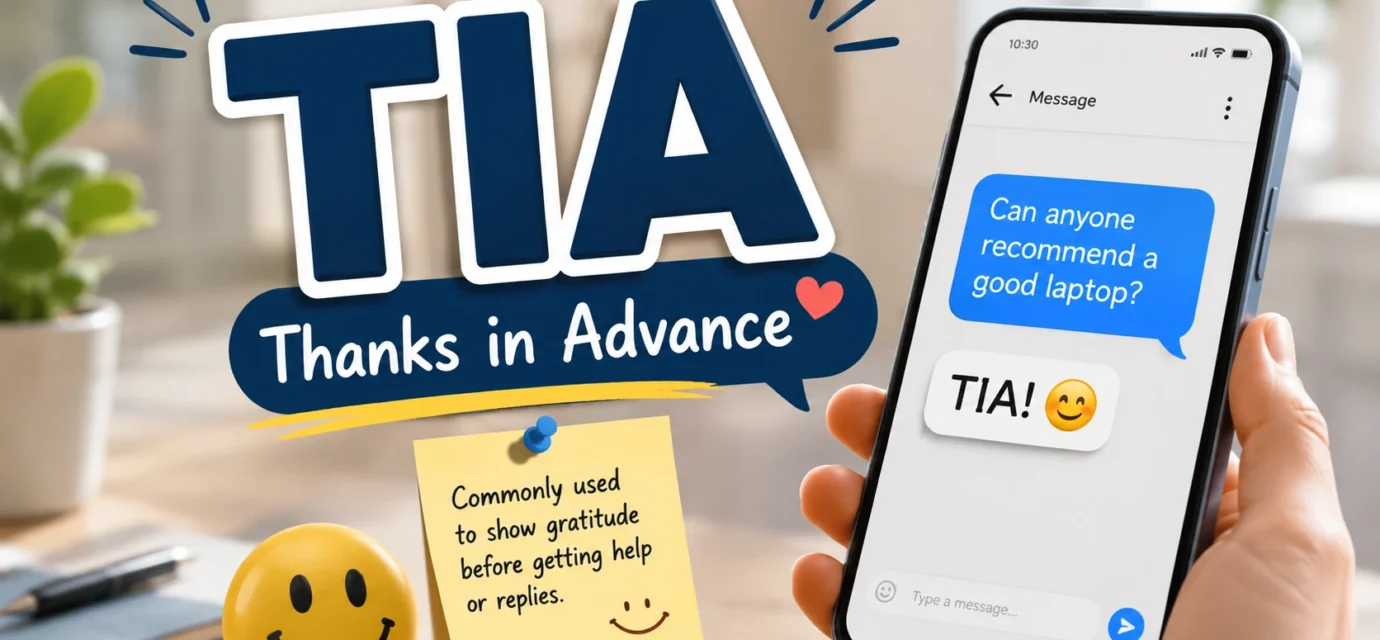

TIA usually means “Thanks in Advance.” What does tia mean? People use it in texts, emails, social media posts, and online discussions when they are asking for help or information and want to thank the other person before they respond.
For example:
- “Can someone tell me where this place is? TIA!”
- “Does anyone know how to fix this issue? TIA.”
- “Looking for recommendations for a good restaurant. TIA!”
The phrase is short, polite, and convenient, which makes it especially common in digital communication.
TIA – Quick Meaning
TIA = Thanks in Advance
It is generally used when you expect someone to help, answer a question, provide information, or do something for you.
Simple Definition
When someone writes TIA, they are essentially saying:
“Thank you beforehand for your help.”
It can sound friendly and casual, depending on the situation.
TIA Examples
Example 1:
“Does anyone know when the meeting starts? TIA!”
Example 2:
“Can someone recommend a good laptop for students? TIA.”
Example 3:
“Please let me know if you have any suggestions. TIA!”
Where Did TIA Come From?
TIA developed as an abbreviation of “Thanks in Advance.” Like many internet abbreviations, it became popular because online communication rewards short, quick expressions.
Message boards, forums, email groups, social media, and chat platforms helped abbreviations such as TIA become familiar to internet users.
Why People Use TIA
Typing “Thanks in advance” takes only a few extra seconds, but TIA is even quicker.
It is particularly useful when someone posts a question to a large group and expects several people might respond.
For example:
“Does anyone know which documents I need for admission? TIA.”
The writer is politely acknowledging that other people are taking time to help.
TIA in Real-Life Conversations
WhatsApp Conversation
Person A:
“Does anyone know if the school is open tomorrow?”
Person B:
“I think it is closed because of the holiday.”
Person A:
“Thanks! TIA to everyone who checked.”
Here, TIA is being used in a casual group-chat environment.
Instagram DM
Person A:
“Hey, do you know where you bought that dress?”
Person B:
“Yeah, I’ll send you the page.”
Person A:
“Thank you! TIA 😊”
The expression sounds warm and informal in this context.
TikTok Comment
Person A:
“Can someone explain what product she is using? TIA!”
Person B:
“It’s a Korean sunscreen.”
The commenter uses TIA because they are asking strangers for information.
Text Message
Person A:
“Can you send me the address when you get a chance? TIA.”
Person B:
“Sure, I’ll send it tonight.”
In this case, TIA makes the request sound more appreciative.
Emotional and Psychological Meaning of TIA
Although TIA simply means “Thanks in Advance,” it can communicate more than gratitude.
It signals that the person recognizes the effort another person may make on their behalf.
It Can Show Politeness
Adding TIA can soften a request.
Compare:
“Send me the details.”
with:
“Could you send me the details? TIA.”
The second version generally feels more considerate.
It Can Make Online Requests Friendlier
Online communication often lacks facial expressions and vocal tone.
A short expression such as TIA can make a request feel less demanding.
A Realistic Scenario
Imagine someone joining a local community group for the first time. They need information about a nearby service, so they write:
“Does anyone know a reliable place for this? TIA!”
They are not simply requesting information. They are also acknowledging the people who may take the time to answer.
How TIA Is Used in Different Contexts
Social Media
TIA is common in Facebook groups, Reddit-style discussions, Instagram comments, and other online communities.
People often use it when asking for recommendations, advice, directions, opinions, or information.
Friends and Relationships
Friends may use TIA casually when asking each other for small favors.
For example:
“Can you send me those photos? TIA 😂”
The abbreviation does not necessarily make the request formal.
Work and Professional Communication
TIA can sometimes appear in workplace emails or messages, particularly in informal office communication.
For example:
“Please send me the updated document when possible. TIA.”
However, in formal business writing, “Thank you in advance” may sound more polished.
Casual vs. Serious Tone
TIA is usually casual or semi-casual.
It works naturally in:
- Group chats
- Online forums
- Social media
- Friendly emails
- Community groups
- Informal workplace messages
For highly formal communication, spelling out “Thank you in advance” is usually safer.
When NOT to Use TIA
TIA is useful, but it does not fit every situation.
Avoid It in Highly Formal Writing
A formal business letter, academic paper, legal document, or official application generally does not need internet abbreviations.
Instead of:
“Please review my application. TIA.”
Use:
“Thank you in advance for reviewing my application.”
Be Careful With Demanding Requests
TIA cannot automatically make a rude request polite.
For example:
“Send me the report today. TIA.”
The message may still sound demanding.
A better version would be:
“Could you please send me the report today if possible? Thank you in advance.”
Consider Your Audience
Not everyone knows internet slang.
If you are communicating with someone unfamiliar with abbreviations, writing the complete phrase is clearer.
Common Misunderstandings About TIA
TIA Does Not Mean “Thank You Already”
Although the idea is similar, TIA specifically means “Thanks in Advance.”
It expresses gratitude before the expected help happens.
TIA Is Not Always Sarcastic
Most of the time, TIA is sincere.
Its meaning depends heavily on context and tone.
TIA Is Not Only Used in Text Messages
You may also see it in:
- Emails
- Facebook groups
- Online forums
- Comment sections
- Community posts
- Workplace chats
It Does Not Guarantee a Response
Writing TIA does not mean someone has to help.
It is simply a way of expressing appreciation in advance.
TIA vs. Similar Expressions
| Expression | Meaning | Typical Tone |
|---|---|---|
| TIA | Thanks in advance | Casual |
| TY | Thank you | Casual |
| TYSM | Thank you so much | Friendly |
| THX | Thanks | Very casual |
| Thanks in advance | Appreciation before help | Polite |
| Please | Polite request | Neutral |
| Much appreciated | Strong appreciation | Polite/professional |
Key Insight
TIA is mainly about timing: you are thanking someone before they provide the expected help.
Variations and Related Forms of TIA
1. TIA
The standard abbreviation for Thanks in Advance.
2. Thanks in Advance
The complete version of TIA and a better choice for formal communication.
3. Thank You in Advance
A slightly more formal version that sounds natural in professional writing.
4. TYIA
Some people use TYIA to mean “Thank You in Advance.”
5. TIA!
Adding an exclamation mark can make the expression feel warmer or more enthusiastic.
6. TIA 😊
An emoji can make the request feel friendlier in casual conversations.
7. TIA guys
This is common when asking a group for help.
8. TIA everyone
Used when addressing several people in an online community or group chat.
9. Many thanks in advance
A more polished expression that can work in professional communication.
10. Much appreciated
This is not an exact abbreviation of TIA, but it serves a similar purpose when expressing appreciation for expected help.
How to Respond When Someone Uses TIA
You do not need to respond specifically to the abbreviation. Simply answer the request.
Casual Replies
- “No problem!”
- “Sure!”
- “Of course!”
- “You’re welcome!”
Funny Replies
- “You’re welcome in advance 😂”
- “I accept the advance thanks!”
- “Haha, got you!”
Mature Replies
- “Sure, I’ll check and let you know.”
- “I’ll see what I can find.”
- “Happy to help.”
Respectful Replies
- “You’re very welcome.”
- “Certainly. I’ll share the information shortly.”
- “I’d be happy to help.”
Regional and Cultural Usage of TIA
Western Culture
TIA is widely understood in English-speaking online communities. It is particularly common in casual digital communication.
Asian Culture
English abbreviations are frequently used online by younger internet users across many Asian countries. TIA may appear in educational groups, social media communities, and messaging apps.
The level of familiarity varies by age and English proficiency.
Middle Eastern Culture
TIA can also appear in English-language online communities, especially when people communicate in international or professional settings.
Local-language communication may use completely different expressions of appreciation.
Global Internet Usage
Because English is widely used online, TIA has become recognizable far beyond traditional English-speaking countries.
Its meaning remains relatively consistent: Thanks in Advance.
Gen Z vs. Millennials
Younger users may recognize TIA but may prefer newer or more conversational expressions depending on the platform.
Millennials who grew up using forums, email groups, and early social media may be particularly familiar with abbreviations such as TIA.
Is TIA Safe for Kids?
Yes. TIA is generally harmless slang.
It simply means “Thanks in Advance.” It does not contain offensive, sexual, or dangerous language.
Children may encounter it in online comments, gaming communities, group chats, or social media.
Parents and teachers should still encourage children to understand the context of online abbreviations rather than assuming every abbreviation has the same meaning.
FAQs About TIA
What does TIA mean in texting?
TIA means “Thanks in Advance.” It is used when someone thanks another person before receiving help, information, or a response.
What does TIA mean on social media?
On social media, TIA usually means “Thanks in Advance.” People commonly use it when asking followers or group members for advice, recommendations, or information.
Is TIA rude?
No. TIA is generally polite and appreciative. However, the overall wording of the message determines whether a request sounds respectful or demanding.
What is the difference between TIA and TY?
TIA means “Thanks in Advance,” while TY means “Thank You.” TIA is normally used before receiving the expected help, while TY is often used after someone has helped.
Can I use TIA in a professional email?
You can use TIA in an informal workplace email, but “Thank you in advance” is usually more appropriate for formal or important professional communication.
What does TYIA mean?
TYIA commonly means “Thank You in Advance.” It has essentially the same purpose as TIA.
Is TIA still used?
Yes. TIA continues to appear in online groups, social media, forums, emails, and casual digital communication.
Conclusion
So, what does TIA mean? In texting and online communication, TIA usually means “Thanks in Advance.”
It is a simple way to show appreciation before someone provides information, assistance, advice, or another favor.
You will often see it in social media posts, group chats, community forums, and informal emails.
The most important thing is context. TIA works naturally in casual digital conversations, while the full phrase “Thank you in advance” is usually better for formal communication.
Once you understand the meaning, you will quickly recognize TIA whenever it appears in a message.