
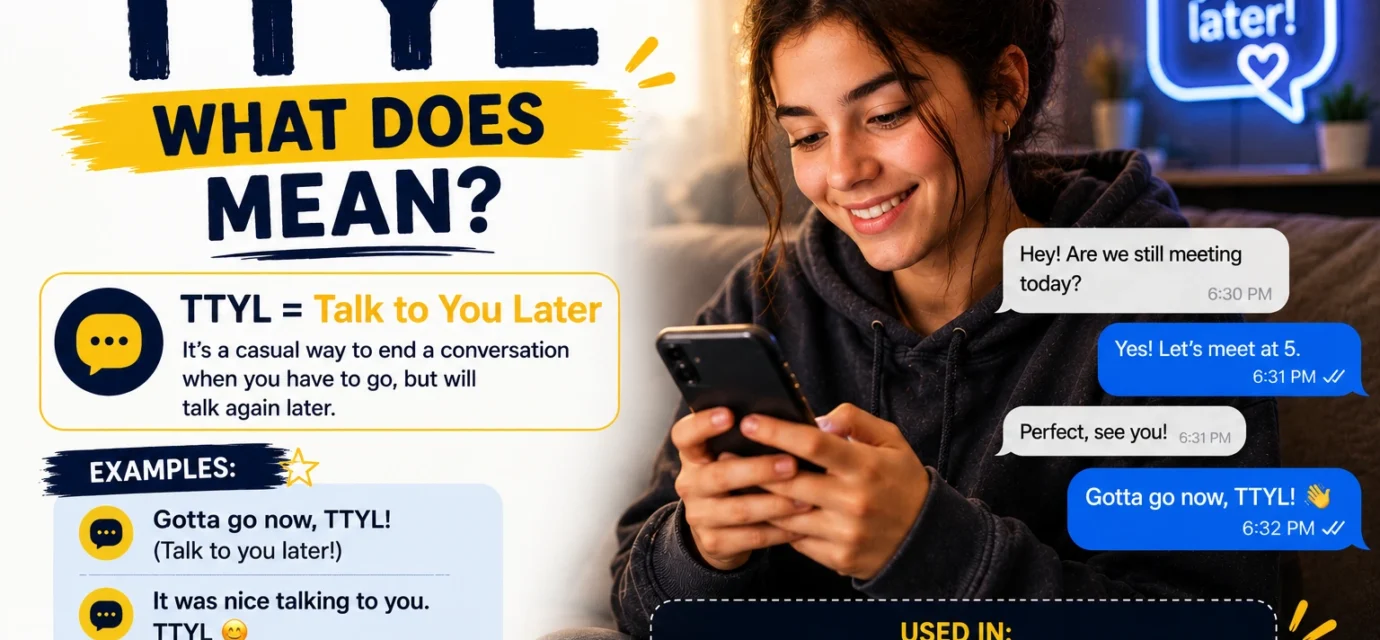

If you have seen “TTYL” in a text message, Instagram DM, Snapchat chat, TikTok comment, or online conversation, you may wonder what does ttyl mean.
TTYL means “Talk To You Later.” It is a common texting abbreviation used when someone is ending a conversation temporarily but expects to communicate again later.
For example:
“I have to go now. TTYL!”
This means:
“I have to go now. Talk to you later!”
TTYL is usually friendly and casual. It does not necessarily mean the person is ending the relationship or avoiding you. It simply suggests that the conversation is being paused.
TTYL – Quick Meaning
What Does TTYL Stand For?
TTYL = Talk To You Later
It is generally used when someone wants to leave a conversation while suggesting they will communicate again.
People may use TTYL to mean:
- “Talk to you later.”
- “I’ll talk to you later.”
- “I have to go for now.”
- “We’ll chat again later.”
- “See you later.”
Examples of TTYL in Text
“I’m heading to class. TTYL!”
Meaning: “I’m going to class now. Talk to you later!”
“Mom’s calling me 😂 TTYL.”
Meaning: “I need to go because my mom is calling. Talk to you later.”
“I’m going offline. TTYL ❤️”
This can sound warm and friendly.
Origin & Background
TTYL developed during the early era of internet chat rooms, instant messaging, and mobile texting.
As people looked for faster ways to communicate, common phrases were shortened into abbreviations.
Expressions such as BRB, LOL, GTG, BTW, and TTYL became part of online communication.
TTYL became particularly useful because it allowed people to leave a conversation without making the goodbye sound permanent.
Social Media Influence
Today, TTYL can appear across many platforms, including:
- Snapchat
- TikTok
- Facebook Messenger
- Discord
- SMS
- Online gaming chats
Although newer slang continues to appear, TTYL remains recognizable because the phrase is straightforward.
How the Meaning Evolved
The core meaning of TTYL has stayed consistent.
What has changed is how people use it emotionally.
A simple:
“TTYL”
may be completely neutral.
A:
“TTYL ❤️”
can feel warmer.
A:
“Okay, TTYL…”
might sound uncertain or slightly uncomfortable depending on the conversation.
Real-Life Conversations
WhatsApp Conversation
Person A:
“Are you still coming tonight?”
Person B:
“Yeah, but I need to finish some work first.”
Person A:
“Okay, TTYL!”
Person B:
“Sure 😊”
Here, TTYL simply means they will continue talking later.
Instagram DM
Person A:
“I have to get ready for dinner.”
Person B:
“Okayyy, TTYL ❤️”
The repeated letters and heart make the goodbye feel warm and friendly.
TikTok Comment
Person A:
“I need to go study 😭”
Person B:
“Good luck! TTYL 😂”
Here, TTYL is a casual farewell.
Text Message
Person A:
“My phone is about to die.”
Person B:
“Okay, TTYL.”
This means the conversation is ending temporarily.
Emotional & Psychological Meaning
TTYL is more than a collection of letters. It can communicate how someone wants to leave a conversation.
Friendly Goodbye
TTYL often sounds less final than simply saying “bye.”
“I have to go. TTYL!”
The phrase suggests the conversation can continue later.
Reassurance
Sometimes people use TTYL to reassure someone that they are not disappearing.
“I’m busy right now, TTYL.”
It communicates that the person is unavailable at the moment but expects to reconnect.
Casual Connection
Because TTYL is informal, it often appears between friends, classmates, family members, or people who communicate casually.
Emotional Warmth
When combined with emojis or affectionate language, TTYL can sound caring.
“TTYL ❤️”
“Okay babe, TTYL 😘”
A Real-Life Communication Scenario
Imagine you are chatting with a friend while getting ready for work.
You suddenly realize you are running late.
Instead of disappearing from the conversation, you might send:
“I’m late for work 😭 TTYL!”
That short message lets your friend know you are leaving temporarily rather than ignoring them.
Usage in Different Contexts
Social Media
TTYL is common in DMs and casual comments.
It works especially well when someone needs to leave a conversation but expects to return later.
Friends and Relationships
Friends frequently use TTYL.
“Got homework to finish. TTYL.”
In romantic conversations, it can sound affectionate depending on the surrounding words.
“Goodnight ❤️ TTYL tomorrow.”
Work and Professional Settings
TTYL is generally too casual for formal professional communication.
Instead of:
“TTYL.”
a workplace message could say:
“I’ll speak with you later.”
or:
“I’ll get back to you shortly.”
In a very informal team chat, TTYL may be acceptable if everyone communicates casually.
Casual vs. Serious Tone
“TTYL” sounds casual.
“TTYL!” can sound cheerful.
“TTYL ❤️” feels warmer.
“Talk to you later.” is more neutral.
“I’ll speak with you later.” sounds more professional.
When NOT to Use TTYL
Formal Emails
Avoid TTYL in formal emails unless the workplace culture is extremely informal.
Academic Writing
TTYL does not belong in essays, assignments, reports, or academic papers.
Professional Applications
Job applications, cover letters, and official correspondence should use standard English.
Serious Conversations
If you are discussing an emotional or important issue, TTYL may sound too casual.
Instead, clearly explain when you will be available again.
When You Do Not Actually Intend to Talk Later
TTYL implies some expectation of future communication.
If you do not intend to continue the conversation, using TTYL may create the wrong impression.
Common Misunderstandings
TTYL Does Not Mean Goodbye Forever
It generally means the person expects to talk again later.
TTYL Does Not Guarantee a Specific Time
When someone says TTYL, they may not know exactly when they will return.
It usually means “later,” not necessarily within a few minutes.
TTYL Is Usually Friendly
A person using TTYL is normally just ending a conversation temporarily.
It should not automatically be interpreted as rejection or disinterest.
Context Can Change the Tone
Compare:
“TTYL 😊”
with:
“TTYL.”
The first can feel warm.
The second may sound more neutral or abrupt, depending on the conversation.
TTYL vs. Similar Slang
| Expression | Meaning | Typical Tone |
|---|---|---|
| TTYL | Talk to you later | Friendly/casual |
| TTYS | Talk to you soon | Friendly |
| TTFN | Ta-ta for now | Playful/old-fashioned |
| BRB | Be right back | Temporary absence |
| GTG | Got to go | Casual |
| G2G | Got to go | Casual |
| CYA | See you | Casual |
| TC | Take care | Friendly |
| BBS | Be back soon | Casual |
Key Insight
TTYL is a friendly way to pause a conversation while suggesting that you expect to communicate again later. It is casual, familiar, and especially useful in texting and social media.
Variations and Types
1. TTYL
The standard abbreviation for “Talk To You Later.”
2. ttyl
The lowercase version feels relaxed and informal.
3. TTYL!
The exclamation mark can make the goodbye sound cheerful.
4. TTYL 😊
The smiley emoji adds warmth and friendliness.
5. TTYL ❤️
The heart can make the message affectionate.
6. TTYL lol
Adds a playful or humorous tone.
7. TTYL bro
A casual goodbye between friends.
8. TTYL tomorrow
Makes the intended time more specific.
9. TTYL soon
Suggests that the person expects to reconnect relatively quickly.
10. Okay, TTYL
A natural way to close a casual conversation.
How to Respond When Someone Uses TTYL
You do not need a complicated response.
Casual Replies
“Sure, ttyl!”
“Okay, talk later!”
“Catch you later!”
Funny Replies
“Don’t disappear 😂”
“I’ll be waiting 😭”
“Later, alligator 😂”
Mature Replies
“Sure, talk to you later.”
“No problem. Speak soon.”
Respectful Replies
“Of course. Take care.”
“Okay, have a good day.”
Affectionate Replies
If the relationship is close:
“Okay ❤️ TTYL.”
“Talk to you later, take care 😘”
Regional & Cultural Usage
Western Culture
TTYL is widely recognized in English-language texting and online communication.
It became especially popular during the early instant-messaging era and remains familiar today.
Asian Culture
English texting abbreviations such as TTYL are commonly used by many young internet users across Asia.
They may appear alongside local languages.
Middle Eastern Culture
TTYL can also be found among English-speaking social media users in Middle Eastern communities.
Its basic meaning remains “talk to you later.”
Global Internet Usage
Because TTYL comes from common English phrases, it has spread through global internet culture.
People who are not native English speakers may also recognize it from social media and messaging apps.
Gen Z vs. Millennials
Millennials often recognize TTYL from the early days of instant messaging.
Gen Z users also understand it, although they may use simpler phrases such as “ttyl,” “later,” “talk soon,” or “bye.”
Is TTYL Safe for Kids?
Yes. TTYL is harmless texting slang.
It simply means “Talk To You Later.”
It does not contain offensive or inappropriate language.
The abbreviation can be used safely in ordinary conversations between friends, classmates, and family members.
FAQs
What does TTYL mean in texting?
TTYL means “Talk To You Later.” It is used when someone is ending a conversation temporarily but expects to communicate again later.
What does TTYL mean on Snapchat?
On Snapchat, TTYL usually means “Talk To You Later.” It is a casual way to say that the person is leaving the conversation for now.
What does TTYL mean on Instagram?
On Instagram, TTYL means “Talk To You Later.” It is commonly used in DMs when someone needs to leave but expects to chat again.
Is TTYL still used?
Yes. Although newer slang appears regularly, TTYL remains recognizable and is still used in casual digital communication.
Is TTYL rude?
No. TTYL is normally friendly and casual. However, the tone can depend on punctuation and the surrounding conversation.
What is the difference between TTYL and BRB?
TTYL means “Talk To You Later” and usually signals that the conversation is ending for now. BRB means “Be Right Back” and suggests the person plans to return shortly.
What should I reply to TTYL?
You can say “Sure, talk later,” “Okay, ttyl,” “See you later,” or simply “Take care.”
Conclusion
So, what does TTYL mean?
TTYL means “Talk To You Later.”
It is a friendly texting abbreviation used when someone needs to leave a conversation but expects to communicate again later.
You may see it in WhatsApp messages, Instagram DMs, Snapchat conversations, TikTok comments, gaming chats, and ordinary text messages.
The phrase is casual and generally positive. It gives the conversation a temporary ending rather than a final goodbye.
If someone says:
“I have to go. TTYL!”
they are usually telling you that they need to leave now but expect to talk again later.
For casual communication, TTYL is perfectly natural. In professional or formal settings, phrases such as “Talk to you later” or “I’ll speak with you later” are clearer and more appropriate.