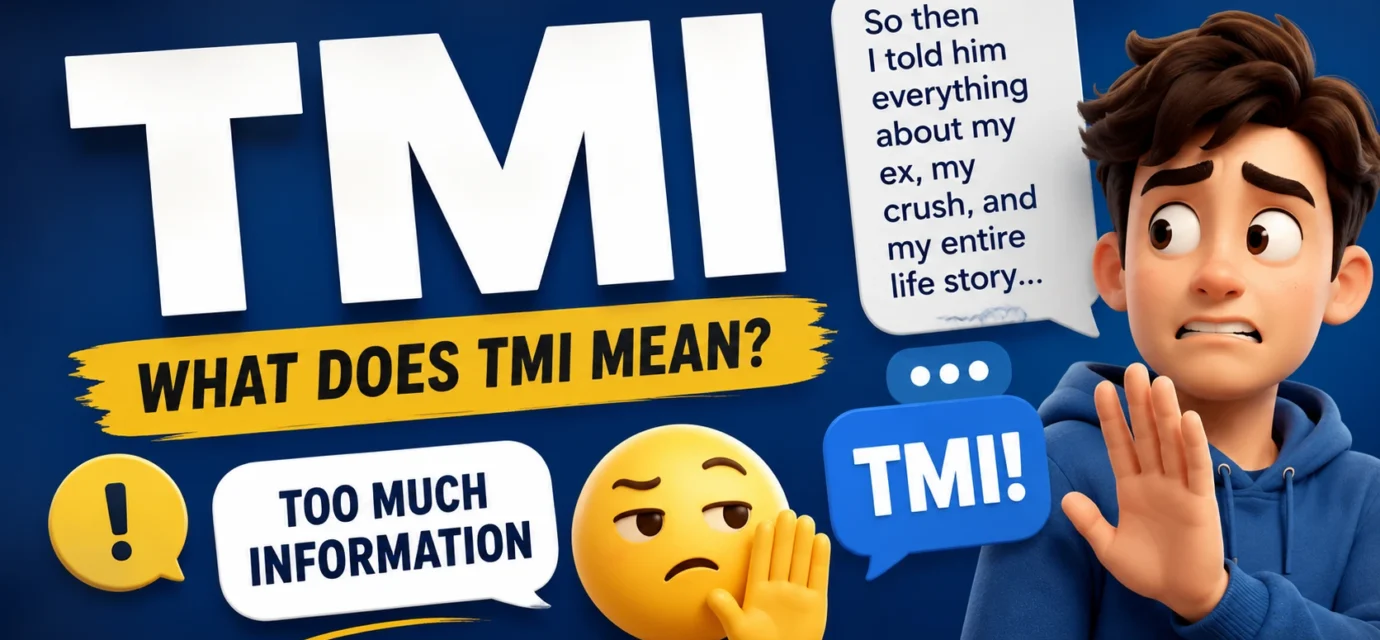

If someone sends you “TMI” in a text message, Instagram DM, Snapchat chat, or TikTok comment, they are usually saying “Too Much Information.”
What does tmi mean? TMI is used when someone shares more personal, embarrassing, private, or unnecessary information than the listener wanted to hear.
For example:
“I told my doctor about my stomach problem in front of everyone.”
“TMI 😭”
Here, TMI means “That was more information than I needed to know.”
It is usually not meant to be cruel. Friends often use it jokingly when someone overshares.
TMI – Quick Meaning
What Does TMI Stand For?
TMI = Too Much Information
It is commonly used as a reaction to information that feels overly personal, detailed, awkward, or unnecessary.
TMI can mean:
- “That is more information than I needed.”
- “You’re oversharing.”
- “I didn’t need to know that.”
- “That’s a little too personal.”
Examples of TMI in Text
“I haven’t showered in three days.”
“TMI 😂”
Another example:
“My stomach has been making weird noises all morning.”
“Okayyy TMI 😭”
The phrase is often used humorously between people who are comfortable with each other.
Origin & Background
The expression “too much information” existed long before texting, but TMI became especially popular as an internet and texting abbreviation.
As online communication became faster, people began shortening frequently used expressions.
TMI became a convenient way to react when someone revealed something private or overly detailed.
The abbreviation spread through text messages, online forums, social media, and everyday conversations.
Social Media Influence
Social media has made oversharing more common.
People regularly share personal stories about relationships, health, family situations, embarrassing experiences, and everyday life.
A quick “TMI” gives other users a simple way to react without writing a long response.
For example:
“I accidentally sent my crush a message meant for my best friend.”
“TMI but I would simply disappear 😭”
Here, TMI can be playful rather than genuinely offended.
How the Meaning Evolved
TMI originally tended to communicate genuine discomfort with oversharing.
Today, it can also be used as a humorous reaction.
Someone might say “TMI 😂” even when they are not actually bothered.
The tone depends on the relationship, subject, and surrounding messages.
Real-Life Conversations
WhatsApp Conversation
Person A:
“I ate so much last night that I couldn’t sleep because my stomach hurt.”
Person B:
“TMI 😂”
The response is playful and suggests that the description was unnecessary.
Instagram DM
Person A:
“My ex texted me at 2 a.m. saying he misses me.”
Person B:
“Girl, TMI 😭”
Here, TMI may mean the information is very personal rather than literally inappropriate.
TikTok Comments
Person A:
“I haven’t washed my hair in five days.”
Person B:
“TMI 💀”
The commenter is joking about the amount of personal information shared.
Text Message
Person A:
“I’m stuck in the bathroom because my stomach is upset.”
Person B:
“Okay TMI 😭”
The reaction means the speaker did not need to provide that much detail.
Emotional & Psychological Meaning
TMI is more than a simple abbreviation. It can communicate a social boundary.
Humor
Friends often use TMI to make an awkward moment funny.
“I accidentally burped during my presentation.”
“TMI 😂”
The response softens the reaction with humor.
Discomfort
Sometimes TMI genuinely means:
“I would rather not hear these details.”
The speaker may feel uncomfortable with the subject.
Surprise
TMI can also express surprise that someone was willing to share something so personal.
“Wait, you actually told him that?”
“TMI 😭”
Setting a Boundary
TMI can politely signal that the conversation has crossed into territory the listener does not want to discuss.
It can be especially useful because the abbreviation is less confrontational than saying:
“Stop talking about this.”
A Real-Life Communication Scenario
Imagine two close friends are discussing a new relationship.
One friend starts describing an extremely private moment in detail.
The other might laugh and say:
“Okay, TMI!”
That does not necessarily mean the friendship is uncomfortable. It may simply mean, “I support you, but I did not need those details.”
Usage in Different Contexts
Social Media
TMI is commonly seen in:
- TikTok comments
- Instagram DMs
- Snapchat
- X
- Group chats
It is especially common when people share personal stories publicly.
Friends and Relationships
Close friends often use TMI playfully.
“I literally cried during the entire movie.”
“TMI 😂”
The response can show teasing rather than criticism.
Work and Professional Settings
TMI can occasionally be used informally among coworkers, but it is better to avoid excessive slang in professional communication.
Instead of writing:
“TMI about your weekend 😂”
you could say:
“That’s quite a personal detail!”
In a workplace, maintaining respectful boundaries is usually more appropriate.
Casual vs. Serious Tone
“TMI 😂” sounds playful.
“TMI.” may sound more serious or uncomfortable.
“Okay, TMI 😭” often sounds teasing.
“That’s TMI.” can clearly communicate a boundary.
When NOT to Use TMI
Formal Communication
Avoid TMI in academic writing, official documents, job applications, and formal emails.
Sensitive Personal Information
Be careful when reacting to someone’s disclosure about trauma, illness, family problems, or other sensitive subjects.
Calling someone’s serious disclosure “TMI” can make them feel embarrassed or dismissed.
With People You Do Not Know Well
A joke that works with a close friend may sound rude when used with a stranger.
When Someone Needs Support
If someone shares personal information because they need help, empathy is usually more appropriate than saying TMI.
For example, if someone says:
“I’ve been struggling lately and don’t know who to talk to.”
A supportive response is better than:
“TMI.”
Common Misunderstandings
TMI Does Not Always Mean the Information Is Bad
The information may simply be too personal or detailed for the situation.
TMI Is Not Always Rude
Among friends, TMI can be playful and affectionate.
The tone often depends on emojis, punctuation, and the relationship between the people.
TMI Does Not Mean “I Don’t Care”
It means “too much information,” not that the listener does not care about the person.
TMI Can Be Positive or Negative
Sometimes people say TMI because they are uncomfortable.
Other times, they say it while laughing because the information is funny or unexpectedly personal.
TMI vs. Similar Slang
| Expression | Meaning | Typical Tone |
|---|---|---|
| TMI | Too much information | Playful/boundary-setting |
| Oversharing | Giving excessive personal details | Neutral/critical |
| NGL | Not gonna lie | Honest/casual |
| IDC | I don’t care | Dismissive |
| OMG | Oh my God | Surprise |
| WTF | What the f*** | Shock/confusion |
| LOL | Laughing out loud | Humorous |
| BRUH | Informal reaction to something surprising | Casual |
Key Insight
TMI usually means “Too Much Information” and is used when someone shares more personal or unnecessary detail than the listener expected. It can be serious, playful, or humorous depending on context.
Variations and Types
1. TMI
The standard abbreviation. It directly signals that someone has overshared.
2. tmi
The lowercase version feels more relaxed and casual.
3. TMI 😂
Often indicates that the speaker is joking rather than genuinely annoyed.
4. TMI 😭
Commonly expresses humorous embarrassment or disbelief.
5. Okay, TMI
A playful way to tell someone they have gone into too much detail.
6. TMI bro
A casual reaction when a friend overshares.
7. TMI lol
Makes the reaction sound less serious.
8. That’s TMI
A clearer way to communicate that the information is too personal.
9. TMI warning
Sometimes used humorously before someone shares a personal or unpleasant detail.
10. Sorry, TMI
Used by the person who realizes they have shared too much information.
How to Respond When Someone Uses TMI
Casual Replies
“My bad 😂”
“Okay okay, I’ll stop 😭”
“Fair enough lol.”
Funny Replies
“You asked! 😂”
“Too late, you already know now 😭”
“No refunds on that information.”
Mature Replies
“Sorry, I got carried away.”
“I understand. I’ll keep the details to myself.”
Respectful Replies
“Sorry if that was too personal.”
“I didn’t mean to make you uncomfortable.”
These responses work especially well when someone uses TMI seriously rather than jokingly.
Regional & Cultural Usage
Western Culture
TMI is widely understood in English-speaking countries and is common in casual conversations.
It has been part of English internet and texting culture for many years.
Asian Culture
Many young English-speaking internet users across Asia recognize TMI through social media and messaging platforms.
It may appear alongside local languages in mixed-language chats.
Middle Eastern Culture
TMI can also be used by younger users familiar with English social media slang.
However, what counts as “too much information” can vary depending on cultural expectations about privacy and personal subjects.
Global Internet Usage
TMI has become internationally recognizable because of social media.
Users often encounter the abbreviation through memes, comments, videos, and online conversations.
Gen Z vs. Millennials
Both Gen Z and Millennials generally understand TMI.
Gen Z may use it with emojis and exaggerated reactions, while Millennials may use it more literally to indicate oversharing.
Is TMI Safe for Kids?
Yes. TMI itself is harmless slang.
It simply means “Too Much Information.”
However, children and teenagers may encounter TMI in conversations involving mature or sensitive subjects.
The abbreviation itself is not inappropriate, but the surrounding content may be.
FAQs
What does TMI mean in texting?
TMI means “Too Much Information.” It is used when someone shares more personal, embarrassing, or unnecessary information than the listener expected.
What does TMI mean on Snapchat?
On Snapchat, TMI usually means “Too Much Information.” It is often used as a playful response when someone shares something personal.
Is TMI rude?
TMI can sound rude if used seriously or toward someone discussing a sensitive issue. Among friends, it is often just playful teasing.
What does TMI mean on TikTok?
On TikTok, TMI usually means “Too Much Information.” People often use it in comments when a creator or another user shares an overly personal detail.
What is an example of TMI?
If someone says, “I haven’t showered in four days,” a friend might respond, “TMI 😂.” The response means the information was more personal than necessary.
Is TMI the same as oversharing?
They are closely related. Oversharing describes the behavior of giving too many personal details, while TMI is often the reaction to that behavior.
What should I reply when someone says TMI?
If you accidentally overshared, you can say “My bad 😂,” “Sorry, I got carried away,” or “Okay, I’ll stop.”
Conclusion
So, what does TMI mean in text?
TMI means “Too Much Information.”
It is commonly used when someone shares something overly personal, embarrassing, graphic, or simply more detailed than necessary.
The expression can be serious, but it is often playful between friends.
A quick “TMI 😂” may simply mean, “You really didn’t need to tell me all that!” A plain “TMI.” can be a stronger signal that someone feels uncomfortable.
The most important thing is to consider the context. If someone is joking with a close friend, TMI can be harmless teasing. If someone is sharing something deeply personal, responding with empathy is usually more appropriate.
Understanding that difference helps you use TMI naturally without accidentally making someone feel dismissed.