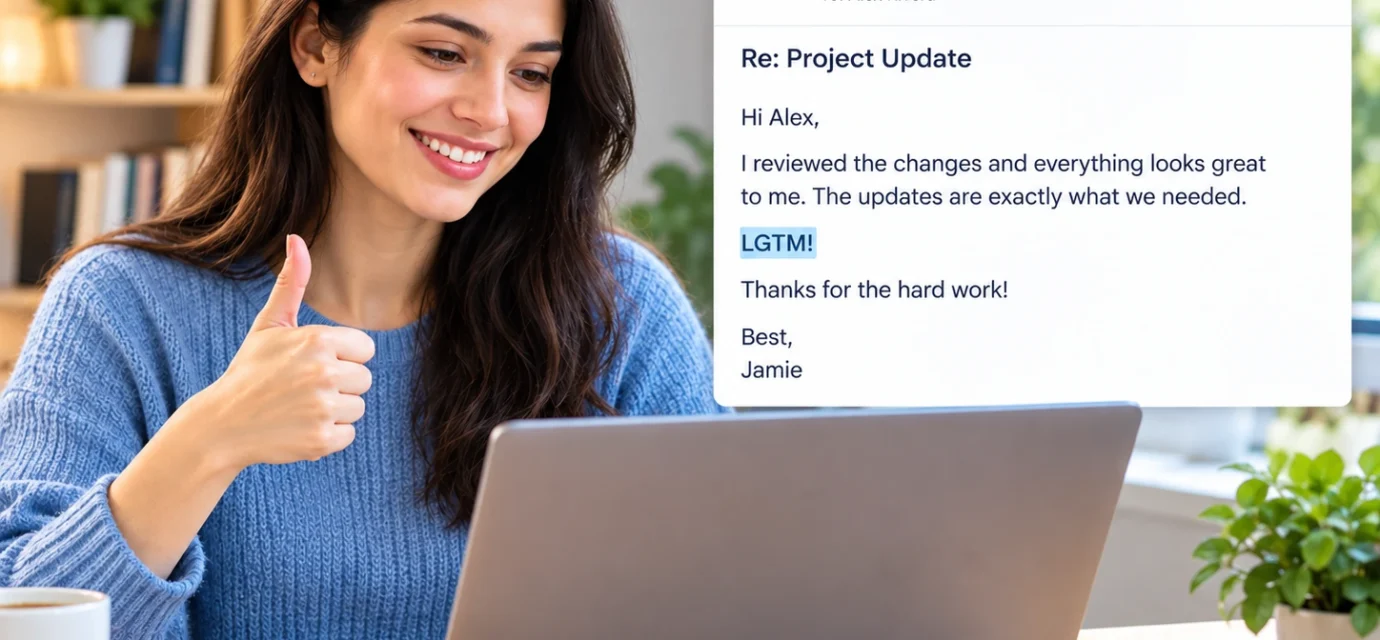

An lgtm email example shows how LGTM is used in professional communication. LGTM means “Looks Good To Me” and is commonly used when someone reviews a document, design, proposal, code change, or project update and approves it.

What Does LGTM Mean in an Email?
LGTM stands for “Looks Good To Me.” It is an informal workplace abbreviation used to communicate that you have reviewed something and do not see an issue with it.
When someone writes “LGTM” in an email, they usually mean:
- I reviewed it and it looks good.
- I have no objections.
- I approve this version.
- You can move forward.
- I do not see any changes that are necessary from my side.
LGTM is especially common in technology, software development, project management, design, marketing, and other workplaces where people regularly review drafts or proposed changes.
For example:
“I’ve reviewed the updated proposal. LGTM.”
This means the sender has looked at the proposal and considers it acceptable.
The abbreviation is generally positive, but the exact level of approval depends on the context. In some workplaces, LGTM simply means “I have no concerns,” while in others it may function as an informal approval to proceed.
LGTM Email Example: When Should You Use It?
An lgtm email example is most useful when the recipient needs a quick confirmation after sending something for review.
1. Reviewing a Document
You can use LGTM after checking a report, proposal, presentation, or other document.
Example:
“Thanks for sending the revised report. I’ve reviewed it, and LGTM. You can share it with the client.”
Here, LGTM tells the sender that the document has been reviewed and is acceptable.
2. Approving a Design
Designers and marketing teams may use LGTM when reviewing graphics, layouts, presentations, or website designs.
Example:
“LGTM. The updated layout looks good. Please proceed with the final version.”
This is short but communicates approval clearly.
3. Software Development
LGTM is particularly familiar in software development and code-review environments.
A developer might write:
“Reviewed the changes. LGTM.”
The statement indicates that the reviewer has examined the proposed code changes and has no objections.
In technical environments, however, LGTM should only be used when the sender has actually completed the appropriate review. It should not be used as a substitute for a required testing, security, compliance, or approval process.
4. Approving a Project Update
Project managers and team members can use LGTM when confirming a proposed plan.
Example:
“I’ve reviewed the updated timeline. LGTM from my side. Let’s move ahead.”
This communicates that the sender accepts the proposed timeline.

7 Professional LGTM Email Examples
The following examples show how LGTM can appear naturally in different professional situations.
LGTM Email Example for a Report
Subject: Report Review
Hi Sarah,
Thanks for sending the revised report. I’ve reviewed the latest version, and LGTM.
The changes address the points we discussed earlier. Please feel free to send the final version to the client.
Best regards,
Michael
LGTM Email Example for a Proposal
Subject: Proposal Approval
Hi James,
I reviewed the updated proposal and the revisions look good. LGTM from my side.
You can proceed with the next stage.
Best,
Emma
LGTM Email Example for a Design
Subject: Updated Design
Hi Alex,
I’ve reviewed the updated design. LGTM.
The revised layout addresses the feedback from the previous review. Please proceed with the final files.
Thanks,
Daniel
LGTM Email Example for Software Changes
Subject: Code Review
Hi Team,
I’ve reviewed the latest changes and everything looks good. LGTM.
You can proceed according to the normal review and deployment process.
Regards,
Chris
LGTM Email Example for a Marketing Campaign
Subject: Campaign Materials
Hi Olivia,
Thanks for sharing the updated campaign materials. I’ve reviewed them, and LGTM.
The messaging and layout look good from my side. Please proceed with the next step.
Best regards,
Ryan
LGTM Email Example for a Schedule
Subject: Project Schedule
Hi Team,
I’ve reviewed the revised project schedule. LGTM.
The proposed dates work for me, so you can continue with the plan.
Best,
David
LGTM Email Example for a Simple Approval
Subject: Final Review
Hi John,
I’ve reviewed the document and everything looks good to me. LGTM.
Please proceed with the final version.
Thanks,
Laura
Is LGTM Formal or Informal?
LGTM is generally considered informal professional shorthand rather than formal business English.
It is perfectly understandable in many modern workplaces, particularly among colleagues who regularly communicate through email, messaging applications, project-management tools, and development platforms.
However, the appropriateness of LGTM depends on your relationship with the recipient.
For example, this is acceptable in an internal team email:
“Reviewed the updated presentation. LGTM.”
For a formal client communication, a clearer alternative may be:
“I’ve reviewed the updated presentation, and everything looks good to me.”
The second version is more explicit and works better when the recipient may not know workplace abbreviations.
What Does LGTM Mean in Different Workplace Situations?
The basic meaning remains “Looks Good To Me,” but the practical meaning can vary slightly according to the situation.
In Software Development
LGTM commonly communicates that a reviewer has examined a change and considers it acceptable.
Example:
“The pull request looks good. LGTM.”
It can indicate approval within a code-review workflow, although organizations may have additional requirements before merging or deploying changes.
In Marketing
A marketer may use LGTM after reviewing advertising copy, graphics, campaign materials, or social media plans.
Example:
“LGTM. The revised copy is ready for scheduling.”
In Business Administration
An employee might use LGTM after checking a document, spreadsheet, meeting agenda, or internal proposal.
Example:
“I’ve checked the spreadsheet. LGTM.”
In Project Management
LGTM can confirm that a timeline, task plan, or project update is acceptable.
Example:
“The revised milestones LGTM. We can move forward.”
LGTM Tone Variations
LGTM is short, so the surrounding words often determine whether the message sounds friendly, funny, sarcastic, or serious.
Funny LGTM Conversation
A casual workplace conversation might look like this:
A: I finally finished the 30-page report.
B: I’m opening it now.
A: Please tell me it’s good.
B: LGTM. You survived another deadline.
The abbreviation remains professional enough for an internal team, while the surrounding language makes the exchange humorous.
Sarcastic LGTM Conversation
LGTM can also appear in playful sarcasm between coworkers who know each other well.
A: I changed the button color for the fifth time.
B: Please tell me this is finally the last version.
A: I think so.
B: LGTM. Until tomorrow.
The sarcasm comes from the surrounding conversation, not from the abbreviation itself.
Playful LGTM Conversation
A friendly exchange can use LGTM in a relaxed way.
A: I updated the presentation like you suggested.
B: Checking it now.
A: Any problems?
B: LGTM! You nailed it.
The exclamation mark makes the approval sound more enthusiastic.
Serious LGTM Conversation
LGTM can also be used in a straightforward professional exchange.
A: Have you reviewed the final contract draft?
B: Yes, I reviewed the sections assigned to me.
A: Any issues?
B: LGTM from my side. Please follow the normal approval process.
Here, the surrounding language makes the limits of the approval clearer.
Real Chat and Email Examples Using LGTM
Example 1: Coworkers
A: Did you review the presentation?
B: Yes, I just finished it.
A: Anything you want changed?
B: LGTM. You can send it.
Example 2: Developer and Team Lead
A: I pushed the latest changes to the branch.
B: I’ll take a look.
A: Let me know if anything needs changing.
B: Reviewed it. LGTM.
Example 3: Marketing Team
A: Here’s the revised campaign copy.
B: Thanks. I’ll review it this afternoon.
A: Great.
B: LGTM from my side.
Example 4: Designer and Manager
A: I updated the homepage based on your feedback.
B: The new version looks much cleaner.
A: Should I send the final files?
B: Yes, LGTM.
Example 5: Project Team
A: I adjusted the delivery schedule.
B: Does the new date work for everyone?
A: It works for me.
B: LGTM. Let’s continue.
Example 6: Friend Working on a Project
A: Can you quickly check this document?
B: Sure, give me a minute.
A: No rush.
B: LGTM. I don’t see anything that needs changing.
Example 7: Client-Facing Situation
A: I’ve attached the final presentation.
B: Thanks. I’ll review it before our meeting.
A: Sounds good.
B: Everything looks good to me.
This example deliberately avoids LGTM because client-facing communication often benefits from plain language.
Example 8: Team Approval
A: Are we okay to use this version?
B: I reviewed it against the requirements.
A: Any outstanding issues?
B: LGTM on my end.
Example 9: Coworker Follow-Up
A: Did you get a chance to check the spreadsheet?
B: Yes, I checked the formulas and totals.
A: Great, thanks.
B: LGTM.
Example 10: Formal Workplace Alternative
A: Could you confirm whether the revised proposal is acceptable?
B: I’ve reviewed it carefully.
A: Any changes required?
B: Everything looks good to me. You can proceed.
How LGTM Works Grammatically
LGTM is an initialism/abbreviation, formed from the first letters of “Looks Good To Me.”
Unlike a normal word, LGTM does not function as a conventional noun or verb. It operates as a shorthand expression or sentence-level response.
Can LGTM Stand Alone?
Yes. In an informal workplace message, you can simply write:
“LGTM.”
This is grammatically equivalent to saying:
“Looks good to me.”
However, a standalone LGTM provides very little detail. If the decision is important, adding a short explanation can make the communication clearer.
Can LGTM Appear in the Middle of a Sentence?
Yes, although it is more natural as a standalone response or at the end of a short sentence.
For example:
“The revised version is LGTM.”
This is understandable, but:
“I reviewed the revised version. LGTM.”
sounds more natural in workplace shorthand.
Does Capitalization Matter?
The most recognizable form is LGTM, usually in uppercase because it is an initialism.
You may occasionally see:
- LGTM
- lgtm
- Lgtm
The meaning generally does not change. Lowercase lgtm can feel more casual, while uppercase LGTM looks more like established workplace shorthand.
Is LGTM Appropriate for Work Emails?
LGTM can be appropriate for internal, informal workplace communication, particularly when colleagues already understand the abbreviation.
It is less suitable when communicating with:
- A new client
- A senior executive you rarely communicate with
- A customer
- A formal institution
- Someone unfamiliar with workplace abbreviations
- A recipient where the exact scope of approval matters
In these cases, write the full phrase instead.
Instead of:
“LGTM.”
Consider:
“I’ve reviewed the document, and everything looks good to me.”
Or:
“I’ve reviewed the proposed changes and have no further comments.”
These alternatives remove ambiguity.
What Is the Difference Between LGTM and “Approved”?
Although LGTM can communicate approval, “Looks Good To Me” and “Approved” are not always identical.
LGTM usually communicates a personal assessment that something appears acceptable.
“Approved” can carry a more formal or authoritative meaning, depending on the organization’s procedures.
For example:
“LGTM from my side.”
may mean that the reviewer has no objections.
By contrast:
“Approved by the department.”
may indicate that a formal organizational approval has been granted.
Do not assume LGTM satisfies a formal approval requirement unless the workplace process explicitly treats it that way.
How to Reply to LGTM
Your response should depend on what you need from the conversation.
Funny Reply
“Perfect. One less thing on my list!”
Serious Reply
“Thanks for reviewing it. I’ll proceed with the next step.”
Neutral Reply
“Thanks for confirming. I’ll move forward.”
More Formal Reply
“Thank you for reviewing the document. I’ll proceed with the final version.”
There is usually no need to respond with another abbreviation unless the conversation is very informal.
LGTM vs Related Workplace Terms
| Term | Meaning | Usage Context | Tone | Popularity | Confusion Risk |
|---|---|---|---|---|---|
| LGTM | Looks Good To Me | Reviews and informal approval | Informal professional | High in technical teams | Low |
| Approved | Officially accepted | Formal decisions and authorization | Formal | Very high | Low |
| OK | Acceptable/all right | General communication | Neutral | Very high | Low |
| ACK | Acknowledged | Technical/team communication | Informal professional | Moderate | Moderate |
| WFM | Works For Me | Agreeing to a suggestion or arrangement | Informal | Moderate | Moderate |
| NACK | Negative acknowledgment/disapproval | Technical communication | Technical | Lower | High |
One important distinction is between LGTM and WFM. “LGTM” normally refers to something being reviewed and considered acceptable, while “WFM” usually means a proposed arrangement, time, or option is acceptable to the person responding.
Who Uses LGTM?
LGTM is especially common among people who work in environments involving frequent reviews and collaborative digital workflows.
Gen Z and Younger Digital Workers
Younger workers are often comfortable using abbreviations in internal digital communication, especially when the workplace already uses messaging tools and collaborative software.
That does not mean every young worker uses LGTM. Workplace culture and industry have a greater effect than age alone.
Millennials
Millennial professionals may encounter LGTM frequently in technology, software, design, project management, and digital workplaces.
Many are familiar with the abbreviation through online collaboration and professional communication.
Older Professionals
Older professionals may use LGTM when their workplace has adopted the abbreviation, but it should not be assumed that every recipient knows it.
When communicating across departments or with external contacts, spelling out the phrase can prevent confusion.
Where Is LGTM Used?
LGTM is primarily a digital workplace abbreviation.
It can appear in:
- Workplace messaging
- Project-management discussions
- Software-development workflows
- Code reviews
- Team discussions
- Document reviews
- Internal collaboration
The meaning remains essentially the same across these contexts: the sender considers something acceptable after reviewing it.
Origin and Internet Culture of LGTM
LGTM developed from the broader tradition of internet and workplace abbreviations rather than being a recent TikTok expression.
The phrase “Looks Good To Me” naturally lends itself to abbreviation because it is frequently used as a short approval response. Digital communication made this kind of shorthand particularly useful.
The abbreviation became strongly associated with software development and online code-review culture. In technical communities, short review comments such as “LGTM” allowed contributors to communicate approval efficiently.
LGTM therefore represents a broader pattern in internet communication: common phrases become shortened when communities repeatedly use them in fast-moving digital conversations.
It is not necessary to interpret LGTM as meme slang. Its primary function is practical communication.
Is LGTM Rude or Offensive?
LGTM is not inherently rude or offensive. It is a neutral-to-positive abbreviation meaning “Looks Good To Me.”
However, a one-word LGTM response can sometimes feel abrupt if the recipient expected detailed feedback.
For example:
“LGTM.”
may sound efficient between experienced coworkers.
But if someone spent days preparing a complicated proposal, a more useful response might be:
“I reviewed the proposal, and everything looks good. Thanks for addressing the earlier feedback.”
The difference is not that LGTM is rude. The difference is the amount of information and acknowledgment provided.
Common Mistakes When Using LGTM
Using LGTM Without Reviewing the Material
Do not write LGTM merely to end a conversation. The phrase implies that you have looked at the material.
Using LGTM for Formal Approval
If a process requires documented authorization, LGTM may not be sufficient.
Assuming Everyone Knows the Abbreviation
Not every coworker, client, or customer will recognize LGTM immediately.
Using It in Highly Formal Emails
For formal correspondence, the full phrase or a more precise statement is usually clearer.
Real-World Observation: Why LGTM Has Lasted
LGTM is interesting because its usefulness comes from repetition rather than trend culture. In workplaces where people constantly review documents, designs, code, and plans, “Looks Good To Me” is a recurring sentence that can easily become an abbreviation. Once a team understands LGTM, three letters can replace an entire sentence without slowing the conversation down. Its durability comes from this practical function: it saves time while preserving a recognizable approval signal. At the same time, its meaning depends on context, because LGTM may indicate personal agreement rather than formal organizational authorization.
FAQ About LGTM Email Examples
What does LGTM mean in an email?
LGTM means “Looks Good To Me.” It is commonly used when someone has reviewed something and considers it acceptable. It can refer to a document, design, proposal, code change, schedule, or other work item.
Is it professional to use LGTM in an email?
LGTM can be professional in informal internal workplace communication. It is particularly familiar in technology and collaborative work environments. For clients, formal correspondence, or unfamiliar recipients, writing “Looks good to me” is usually clearer.
Is LGTM rude to reply with in an email?
LGTM is not inherently rude. However, using only “LGTM” can feel brief or abrupt when someone expects detailed feedback. Adding a sentence explaining what you reviewed can make the response more helpful.
What’s the difference between LGTM and saying “Looks good to me” out loud?
There is no major difference in basic meaning. LGTM is simply the abbreviated written form of “Looks Good To Me.” The abbreviation is more associated with quick digital workplace communication.
Does LGTM mean the same thing in a group email and a one-to-one email?
Generally, yes. In both situations, LGTM communicates that the sender considers something acceptable. However, in a group email, adding context can be useful because multiple people may need to understand exactly what has been reviewed or approved.
Can I use LGTM in an email to my boss?
You can use it if your workplace communication is informal and your boss is familiar with the abbreviation. If the message concerns an important decision or formal approval, a complete sentence is safer. For example, “I’ve reviewed the proposal and have no further comments” is clearer.
What does LGTM mean in software development?
In software development, LGTM means “Looks Good To Me” and is commonly used during code review. It generally communicates that the reviewer considers the proposed changes acceptable. Organizations may still require testing, additional review, or other formal checks before a change is merged or released.
Is LGTM the same as “approved”?
Not necessarily. LGTM usually expresses that something looks acceptable to the person reviewing it. “Approved” can carry a more formal meaning when an organization has a defined approval process. Always follow the specific approval requirements of your workplace.
PAA Questions About LGTM
What does LGTM stand for?
LGTM stands for “Looks Good To Me.” It is an abbreviation used to express agreement or approval after reviewing something.
What does LGTM mean in business?
In business communication, LGTM usually means that the sender has reviewed a proposal, document, design, schedule, or other item and considers it acceptable. It is more common in informal internal communication than in highly formal correspondence.
What is an example of LGTM?
A simple example is: “I reviewed the revised proposal. LGTM. Please proceed with the final version.” This tells the recipient that the sender reviewed the proposal and has no objections.
What is a professional alternative to LGTM?
Professional alternatives include “Looks good to me,” “I have no further comments,” “I approve the proposed changes,” or “I’ve reviewed the document and have no objections.” The best option depends on whether you are expressing informal agreement or formal approval.
Read More: LGTM Meaning: 5 Powerful Uses in Text
Conclusion
An lgtm email example demonstrates a simple but widely recognized workplace abbreviation: LGTM means “Looks Good To Me.” It is used when someone reviews a document, proposal, design, code change, schedule, or other work and considers it acceptable.
LGTM is most natural in internal, informal professional communication. It is especially common in technology and collaborative digital workplaces, where short review responses save time.
Usage Tips
- Use LGTM when you have genuinely reviewed the material.
- Add a short explanation when the decision needs more context.
- Use the full phrase with clients or unfamiliar recipients.
- Do not treat LGTM as formal approval unless your workplace process says it is.
Common Mistakes
- Writing LGTM without actually reviewing something.
- Assuming every recipient understands the abbreviation.
- Using LGTM when formal authorization is required.
- Giving only “LGTM” when detailed feedback is expected.
When to Use or Avoid LGTM
Use LGTM for quick internal approvals, document reviews, project discussions, and technical collaboration. Avoid it in highly formal correspondence when plain language would be clearer. When the distinction between informal agreement and formal approval matters, state exactly what you reviewed and what you are approving.