
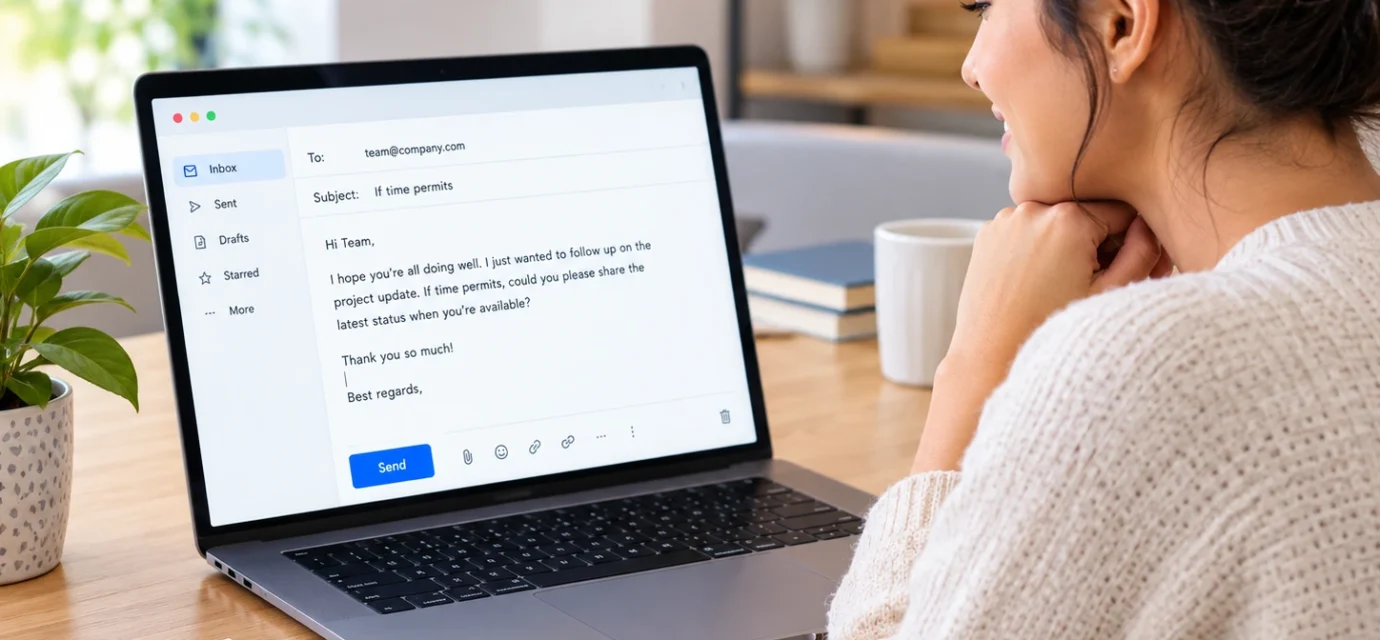

“If time permits” means if there is enough available time to do something. In an email, it is commonly used to make a request politely while showing that the task is not necessarily urgent or mandatory.
What Does “If Time Permits” Mean in an Email?
“If time permits” is a polite and professional expression used when asking someone to do something only if they have enough time or availability.
For example:
If time permits, please review the attached document before tomorrow’s meeting.
This means the sender would appreciate the review, but understands that other priorities may come first.
The phrase is especially common in professional emails, workplace requests, academic communication, and formal correspondence.


5
7 “If Time Permits” Email Examples
1. Simple Professional Request
EmailDocument Review
Document Review
Hi [Name],
If time permits, could you please review the attached document before our meeting tomorrow?
I would appreciate any feedback you may have.
Best regards,
[Your Name]
2. Asking a Coworker for Help
EmailQuick Request
Quick Request
Hi [Name],
If time permits, could you please take a quick look at the report and let me know if anything needs to be updated?
There is no immediate rush.
Thanks,
[Your Name]
3. Requesting Feedback
EmailFeedback Request
Feedback Request
Dear [Name],
If time permits, I would appreciate it if you could review my proposal and share your feedback.
Your suggestions would be very helpful before I finalize the document.
Kind regards,
[Your Name]
4. Asking Someone to Complete a Task
EmailTask Request
Task Request
Hi [Name],
If time permits, please update the spreadsheet before the end of the week.
If you are unable to get to it, just let me know.
Best,
[Your Name]
5. Friendly Workplace Email
EmailQuick Favor
Quick Favor
Hi [Name],
If time permits, could you have a look at the presentation before Friday?
I’d really appreciate your thoughts, but I understand if your schedule is busy.
Thanks,
[Your Name]
6. Formal Business Email
EmailRequest for Review
Request for Review
Dear [Name],
If time permits, I would be grateful if you could review the attached proposal at your convenience.
Any comments or recommendations you can provide would be greatly appreciated.
Kind regards,
[Your Name]
7. Asking a Manager for Review
EmailProposal Review
Proposal Review
Dear [Name],
If time permits, could you please review the attached proposal before our next meeting?
I would value your feedback and will incorporate any suggested changes.
Thank you for your time.
Best regards,
[Your Name]
Is “If Time Permits” Professional?
Yes. “If time permits” is professional, polite, and appropriate for workplace emails.
It communicates that you understand the recipient may have other priorities. This makes it useful when you want to request something without making the request sound demanding.
For example:
If time permits, could you review this report?
sounds less forceful than:
Please review this report today.
However, if the task has a firm deadline, you should state the deadline clearly rather than relying only on “if time permits.”
Alternatives to “If Time Permits”
You can use several similar expressions depending on the tone you want.
| Phrase | Tone | Example |
|---|---|---|
| If time permits | Professional | If time permits, please review the report. |
| If you have time | Friendly | If you have time, could you check this? |
| If your schedule allows | Professional | If your schedule allows, please review the proposal. |
| At your convenience | Polite/formal | Please review the document at your convenience. |
| When you have a moment | Friendly | When you have a moment, could you check this? |
| When you get a chance | Casual | When you get a chance, please look over the file. |
“If Time Permits” vs. “If You Have Time”
Both expressions have essentially the same meaning, but their tone is slightly different.
“If time permits” sounds more formal and polished:
If time permits, I would appreciate your feedback.
“If you have time” sounds more conversational:
If you have time, I’d appreciate your feedback.
For a formal business email, “if time permits” or “if your schedule allows” may fit better.
When Should You Use “If Time Permits”?
Use the phrase when:
- The request is not extremely urgent.
- You want to respect someone’s workload.
- You are asking for optional feedback.
- You want someone to review something when they are available.
- You are making a secondary request alongside a more important task.
For example:
If time permits, please review the presentation before the meeting.
This makes it clear that the request is useful but not necessarily the highest priority.
When Should You Avoid It?
Avoid using “if time permits” when a task has a strict deadline and must be completed.
Instead of:
If time permits, please submit the report today.
use:
Please submit the report by 5:00 PM today.
This removes ambiguity and makes the expectation clear.
You should also avoid the phrase if the recipient might interpret the task as completely optional when it is actually required.
How to Make the Phrase Sound More Natural
A common mistake is using “if time permits” without explaining what you want the recipient to do.
Instead of:
If time permits, please.
write:
If time permits, could you please review the attached document?
You can also make the request warmer:
If time permits, I’d really appreciate your feedback on the attached proposal.
For formal communication:
If time permits, I would appreciate your review of the attached proposal at your convenience.
Frequently Asked Questions
What does “if time permits” mean in an email?
“If time permits” means if there is enough available time to complete something. It politely indicates that the requested task can be done when the recipient has sufficient time. It often suggests that the request is not the recipient’s most urgent priority.
Is “if time permits” professional?
Yes. It is a professional expression frequently used when making polite requests. It can be particularly useful when you want to respect someone’s workload or schedule. For very formal emails, “if your schedule allows” is another suitable option.
Is “if time permits” polite?
Yes. The expression generally sounds considerate because it recognizes that the recipient may be busy. It avoids making the request sound like an immediate demand. However, you should still provide a deadline when one is important.
What is another way to say “if time permits”?
You can say “if you have time,” “if your schedule allows,” “at your convenience,” or “when you have a moment.” The best choice depends on the level of formality. “If you have time” is more conversational, while “if your schedule allows” sounds more professional.
Is “if time permits” too formal?
It can sound somewhat formal in casual conversation, but it is perfectly natural in professional emails. If you are writing to a close coworker, “if you have time” or “when you get a chance” may sound more relaxed. For business correspondence, “if time permits” works well.
Does “if time permits” mean the task is optional?
Not necessarily. It usually indicates that the request can be completed when the recipient has time, but the context determines whether it is optional. If the task is required, clearly state the deadline or expectation.
Final Thoughts
“If time permits” is a useful phrase for making polite, professional requests without sounding demanding. It shows consideration for the recipient’s workload and is particularly appropriate when the request is secondary or flexible.
For casual communication, “if you have time” is a natural alternative. For formal business emails, “if your schedule allows” or “at your convenience” can also work well.
Read More:If Time Permits Meaning: 7 Clear Uses & Examples
Quick Usage Tips
- Use it for flexible or non-urgent requests.
- Add a clear deadline when one exists.
- Use “if you have time” for a more conversational tone.
- Avoid it when a task is mandatory and time-sensitive.
Common Mistakes
- Making an urgent task sound optional.
- Using the phrase without explaining the request.
- Omitting an important deadline.
- Using overly formal wording in a casual workplace conversation.