
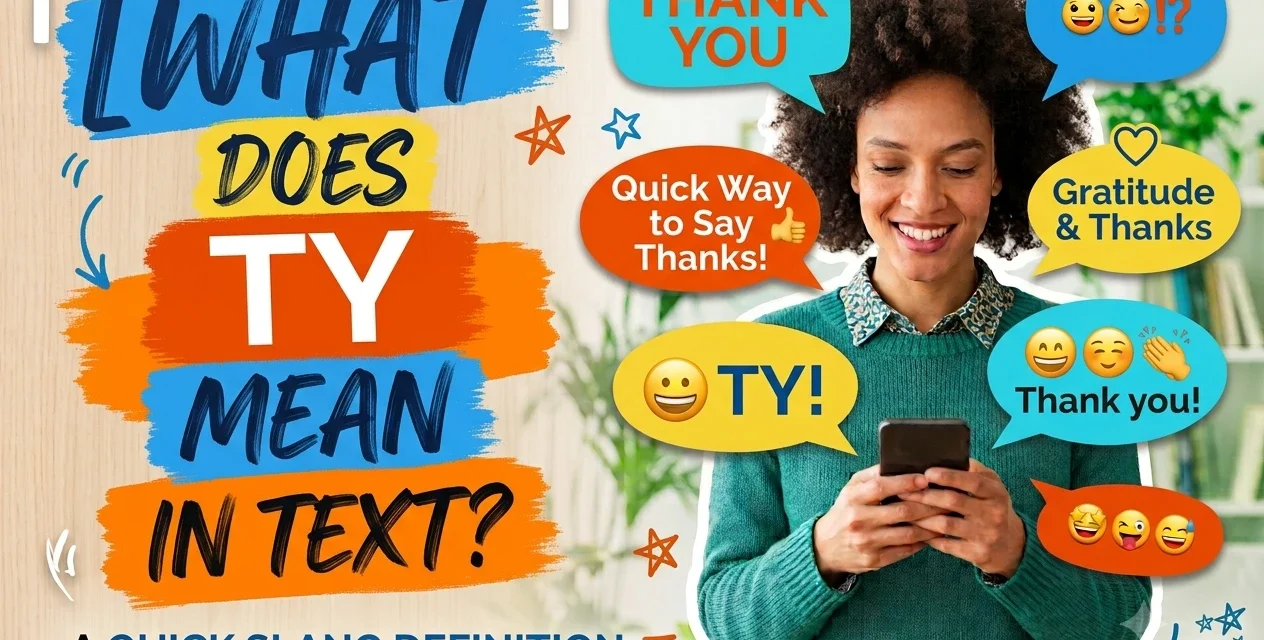

If someone texts you “TY,” it usually means “thank you.” It is a short, informal texting abbreviation used to express appreciation in messages, WhatsApp chats, DMs, and other casual online conversations.
What Does TY Mean in Text?
TY means “thank you” in texting. It is one of the simplest abbreviations used in digital communication and is usually sent when someone wants to acknowledge help, kindness, information, or a favor without typing the full phrase.
For example:
- “TY for helping me!” = “Thank you for helping me!”
- “Got it, TY.” = “Got it, thank you.”
- “TY so much 😊” = “Thank you so much.”
- “TY!” = “Thank you!”
When someone sends you “ty”, there is normally no hidden meaning. The exact tone depends on the surrounding conversation, punctuation, emojis, and relationship between the people messaging.
People search for “what does ty mean in text” because short abbreviations can be confusing when they appear without context. In most ordinary conversations, however, the answer is straightforward: TY = thank you.
TY Meaning and Explanation
Is TY an acronym, abbreviation, or slang word?
TY is best described as an initialism or texting abbreviation.
The letters come from the first letters of Thank You:
T + Y = TY
It is commonly used in informal digital communication rather than formal English.
Although people sometimes loosely call TY “slang,” it is more accurately described as texting shorthand.
What is the full form of TY?
The standard full form is:
TY = Thank You
It is usually typed without periods:
- TY
- ty
You may occasionally see “T.Y.”, but this is much less common in modern texting.
What does TY mean when someone texts it to you?
If someone sends:
“TY for coming!”
they mean:
“Thank you for coming!”
If they say:
“TY 😊”
they are simply thanking you.
The abbreviation itself does not automatically indicate romance, sarcasm, anger, or excitement. Those meanings come from the surrounding context.
For example:
“TY!! ❤️”
sounds warmer than:
“ty.”
But both fundamentally mean “thank you.”
Why Do People Use TY?
It saves time
Typing two letters is faster than typing “thank you,” especially during rapid conversations.
It keeps messages short
Texting is often conversational and abbreviated. TY allows the sender to acknowledge something without interrupting the flow of the conversation.
It feels casual
“Thank you” can sound slightly more formal, while “ty” fits naturally into relaxed messaging.
It works across digital communication
TY is widely recognizable in casual online communication, so people can often understand it without needing an explanation.
Where Is TY Used?
SMS and iMessage
TY can appear naturally in ordinary text messages.
For example:
A: I sent you the address.
B: TY! Got it.
Here, TY simply means “thank you.”
WhatsApp users commonly use TY as a quick acknowledgment.
“TY for reminding me!”
means:
“Thank you for reminding me!”
It may appear with emojis, punctuation, or other texting shorthand.
Instagram and Snapchat DMs
TY also works naturally in private messages.
“TY 😊 I really appreciate it.”
The meaning remains “thank you.”
Discord
In casual Discord conversations, TY can be used when someone provides information, helps with a problem, or shares something useful.
For example:
“TY for the link!”
means:
“Thank you for the link!”
The meaning does not normally change between these platforms.
TY Variations and Capitalization
The most common forms are:
- ty — casual and very common
- TY — same meaning, sometimes more emphatic
- Ty — usually just sentence-style capitalization
- TYSM — “thank you so much”
- TYVM — “thank you very much”
Capitalization does not normally change the definition.
Compare:
“ty for your help”
and
“TY FOR YOUR HELP”
Both express thanks, although the second may look much more emphatic because of the capitalization.
Tone and Context Variations
TY itself is neutral, but the surrounding message can make it sound funny, sarcastic, playful, or serious.
Funny TY
A: I saved you the last slice of pizza.
B: You actually did?
A: Yes, I’m being generous today.
B: TY, you’re officially my favorite person 😂
Here, TY is simply an informal thank-you inside a humorous conversation.
Sarcastic TY
A: I told everyone you were going to be late.
B: You did what?
A: I was just being honest.
B: TY for that unnecessary announcement 🙃
The sarcasm comes from the rest of the message, not from TY itself.
Playful TY
A: I found the shoes you were looking for.
B: No way!
A: Sending you the link now.
B: TY! You’re the best 😭
The abbreviation makes the response quick and casual.
Serious TY
A: I really appreciate you staying with me through all of this.
B: Of course.
A: I don’t know what I would have done without you.
B: TY for saying that. It means a lot.
Here, TY is part of a sincere conversation.
Real Chat Examples of TY
1. Friends
A: I sent you the notes from today’s class.
B: TY! I missed half the lecture.
A: No problem.
B: Seriously, you saved me.
2. Partners
A: I ordered your favorite food.
B: Aww, TY ❤️
A: I knew you were hungry.
B: You know me too well.
3. Coworkers
A: I’ve attached the updated report.
B: TY, I’ll review it now.
A: Let me know if anything needs changing.
B: Will do.
4. Parent and child
A: I put your lunch in the fridge.
B: TY, Mom.
A: Don’t forget to take it with you.
B: I won’t.
5. Siblings
A: I borrowed your charger but left it on your desk.
B: TY.
A: You’re welcome.
B: At least you remembered this time 😂
6. Stranger or new contact
A: The meeting is in Room 204.
B: TY for letting me know.
A: No problem.
B: I was about to go to the wrong room.
7. School friends
A: I took a picture of the homework questions.
B: TY!
A: I’ll send them now.
B: Perfect.
8. Asking for help
A: Can you send me the document again?
B: Sure, sending it now.
A: TY!
B: You’re welcome.
9. Online purchase
A: Your order has been shipped.
B: TY for the update.
A: You’re welcome.
B: Hopefully it arrives soon.
10. Group chat
A: I booked the table for 8 pm.
B: TY!
C: Perfect.
D: Thanks for organizing it.
11. Friendly conversation
A: Don’t forget your appointment tomorrow.
B: TY for reminding me.
A: I knew you’d forget 😂
B: Honestly, you’re right.
12. Emotional conversation
A: Thanks for listening to me tonight.
B: Always.
A: TY. I really needed someone to talk to.
B: I’m glad I could be there.
Grammar and Language Role
What part of speech is TY?
TY is not a conventional part of speech in the same way that “thank” or “you” are. It functions as a texting expression or abbreviation representing the phrase “thank you.”
It can function as a complete conversational response.
Where does TY appear in a text?
TY can appear at the beginning, middle, or end of a casual message.
Examples:
- “TY for your help.”
- “I got it, TY.”
- “TY, I really appreciate it.”
- “TY so much!”
Can TY stand alone?
Yes.
Someone can simply send:
TY!
and communicate a complete message of appreciation.
This is one reason the abbreviation is so convenient.
Can TY replace a full sentence?
In informal texting, yes. A standalone “TY” can function as a complete conversational response equivalent to “Thank you.”
However, it is not suitable for every context.
Formal vs. informal use
TY is informal.
Use it comfortably with:
- Friends
- Family
- Classmates
- Close coworkers
- Casual online contacts
Use “Thank you” instead when communicating with:
- A manager
- A teacher or professor
- A client
- A government official
- A professional organization
How to Reply to TY
Funny reply
“You’re welcome. I accept payment in snacks 😂”
This works when you’re chatting casually with a friend.
Serious reply
“You’re very welcome. I’m glad I could help.”
Use this when the conversation is more sincere or important.
Flirty reply
“Anything for you 😉”
This can work when the existing conversation is clearly romantic or playful.
Neutral reply
“You’re welcome!”
This is the safest response in almost any casual conversation.
You can also simply react to the message with an emoji if the platform supports message reactions.
TY vs. Similar Texting Terms
| Term | Meaning | Usage Context | Tone | Popularity | Confusion Risk |
|---|---|---|---|---|---|
| TY | Thank you | Casual texts and DMs | Friendly | High | Low |
| TYSM | Thank you so much | Stronger appreciation | Warm | High | Low |
| TYVM | Thank you very much | More emphatic/formal-sounding | Polite | Moderate | Low |
| THX | Thanks | Casual texting | Informal | High | Low |
| TNX | Thanks | Informal messages | Casual | Lower | Medium |
| YW | You’re welcome | Reply to thanks | Casual | High | Low |
The closest terms people commonly confuse with TY are TYSM, TYVM, and THX.
The opposite conversational response is often YW, meaning “you’re welcome.”
Who Uses TY?
Age group
TY is used by people across different age groups who participate in digital communication. It is particularly natural among people who are comfortable with texting abbreviations, but it is not exclusive to teenagers or Gen Z.
Gen Z vs. Millennials
Both Gen Z and Millennials can use TY.
Gen Z texting may combine TY with lowercase writing, emojis, repeated punctuation, or other abbreviations:
“tyyy 😭❤️”
Millennials may also use TY but may be more likely to switch between abbreviations and the complete phrase depending on the context.
These are general communication patterns rather than rules. Individual texting habits vary widely.
Regional usage
TY is understandable across English-language digital communication internationally. It is not restricted to the United States or United Kingdom.
People in different countries may have different preferences for texting shorthand, but TY retains the same basic meaning: “thank you.”
Origin and Internet Culture
TY comes from the straightforward practice of shortening common phrases for digital communication.
It is difficult to identify one person or exact moment when TY was first used. Like many texting abbreviations, it developed through the broader culture of online chat, SMS, gaming, forums, and instant messaging.
It should not be described as a TikTok-created term. The abbreviation belongs to the older tradition of digital shorthand that existed before modern social media platforms became dominant.
The logic is simple: the first letters of Thank You create a compact two-letter form:
Thank → T
You → Y
Over time, TY became recognizable enough that many users can understand it immediately without thinking about the individual letters.
Safety and Appropriateness
Is TY rude?
No. TY is not inherently rude.
However, a very short “ty” can sometimes feel less warm than a complete “thank you,” particularly in a sensitive conversation.
For example:
“ty.”
may feel more distant than:
“Thank you so much. I really appreciate it.”
That difference comes from context and communication style, not from a different dictionary meaning.
Is TY profanity?
No. TY is not profanity and does not contain explicit language.
Is TY appropriate at school or work?
It depends on the situation.
A quick message to a classmate such as:
“TY for sending the notes.”
is perfectly normal.
A formal email to a teacher, manager, or client would usually be better as:
“Thank you for sending the information.”
Cultural sensitivity
There is no major cultural sensitivity issue associated with TY itself. The main consideration is register: informal shorthand may not be appropriate in formal communication.
Real-World Observation
TY has remained useful because it shortens one of the most frequently used polite expressions in everyday communication without making the meaning difficult to understand. Unlike slang that depends on a particular meme or online trend, TY is functional shorthand. People use it because it is quick, recognizable, and convenient. Its simplicity also makes it adaptable: “ty,” “TY,” “tysm,” and “thx” can all express appreciation while allowing the writer to adjust the level of emphasis or informality.
Frequently Asked Questions
What does TY mean in text messages?
TY means “thank you.” It is an informal abbreviation formed from the first letters of “thank” and “you.” It is commonly used in texts, chats, DMs, and other casual digital conversations.
Is it rude to reply with just TY in a text?
Usually, no. A standalone “TY” is a normal way to express thanks in casual texting. However, in an emotional or formal situation, spelling out “thank you” can sound warmer and more respectful.
What’s the difference between texting TY and saying it out loud?
TY is mainly a written abbreviation. When spoken aloud, people normally say “thank you,” rather than pronouncing the letters “T-Y.” The abbreviation is designed for written digital communication.
Does TY mean the same thing in a group chat and a 1-on-1 text?
Yes. TY normally means “thank you” in both settings. The group or individual context can change the tone, but it does not normally change the abbreviation’s meaning.
Does TY mean thank you from a girl or a guy?
Yes. TY does not have a gender-specific meaning. If a girl or guy sends “TY,” the standard meaning is “thank you.”
Is TY the same as TYSM?
No, although they are closely related. TY means “thank you,” while TYSM means “thank you so much.” TYSM generally expresses stronger appreciation.
Is TY the same as THX?
Both can express thanks, but THX means “thanks,” while TY means “thank you.” They are both informal and commonly understood in digital communication.
What does TY mean on WhatsApp?
On WhatsApp, TY normally means “thank you.” It can be used after someone provides information, helps with something, sends a file, gives advice, or does a favor.
PAA-Optimized Questions
What does TY mean from a girl?
TY normally means “thank you” regardless of whether the sender is a girl or a guy. It does not automatically indicate flirting or romantic interest.
What does TY mean from a guy?
A guy using TY is normally just saying “thank you.” The surrounding conversation is needed to determine whether there is any additional tone.
What does TY mean on Instagram?
On Instagram, TY commonly means “thank you,” especially in DMs. For example, “TY for the recommendation” means “Thank you for the recommendation.”
What does TY mean on Snapchat?
On Snapchat, TY generally means “thank you.” It is informal shorthand used in quick conversations.
What does TY mean in WhatsApp chat?
TY means “thank you” in WhatsApp chat. It is simply a shortened way to express appreciation.
Conclusion
TY means “thank you” in text. It is a common, informal abbreviation formed from the first letters of “thank” and “you.” It can be used alone or inside a longer message and is widely understood in casual digital communication.
Usage tips
- Use TY for quick, casual thanks.
- Use TYSM when you want to show stronger appreciation.
- Use “Thank you” in formal or professional communication.
- Pay attention to punctuation and emojis when interpreting tone.
Common mistakes
- Don’t confuse TY with TYSM; the latter adds “so much.”
- Don’t assume TY is automatically sarcastic or romantic.
- Don’t treat uppercase TY as a completely different abbreviation.
- Don’t use TY in formal documents simply because it is understood.
When to use and when to avoid TY
Use TY with friends, family, classmates, casual coworkers, and online contacts. Avoid it in formal emails, official documents, academic writing, and other situations where standard professional language is expected.
The simple rule is: if someone texts “TY,” they are almost certainly saying “thank you.”