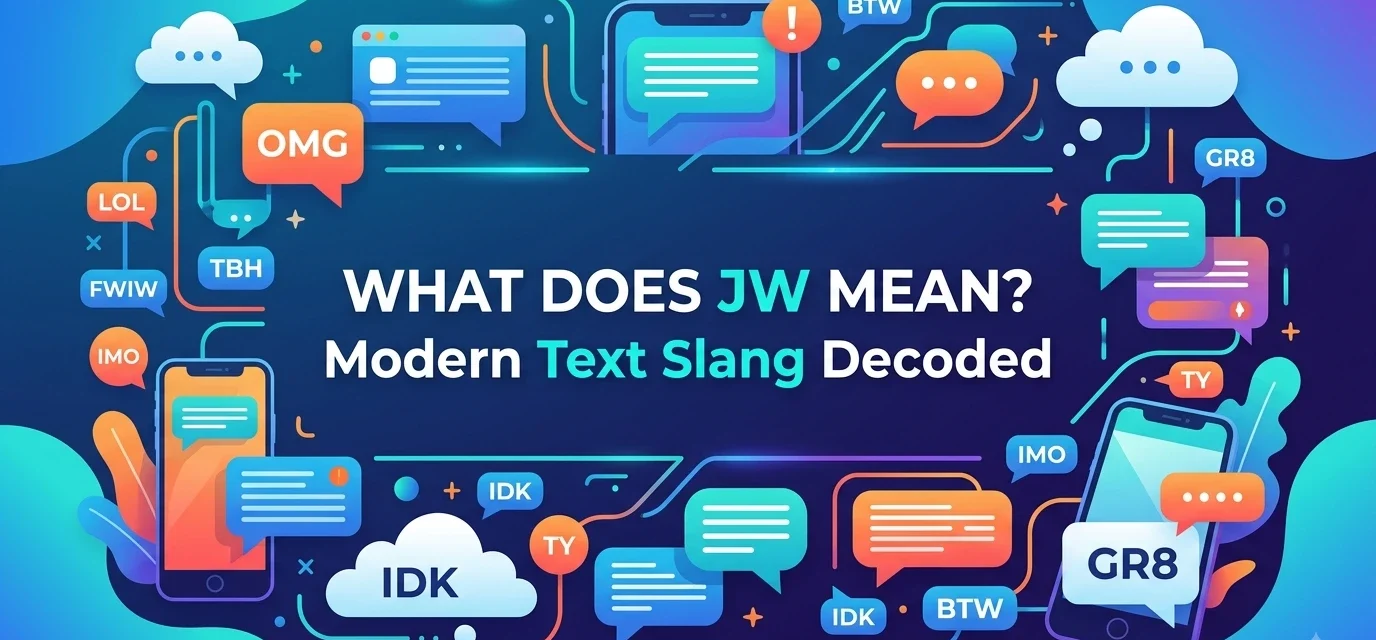

What does JW mean? In texting and online communication, JW most commonly means “Just Wondering.” People use it when they want to ask a question casually without making it sound too serious or demanding.
For example:
“JW, are you coming tonight?”
This means:
“Just wondering, are you coming tonight?”
JW is common in text messages, WhatsApp chats, Instagram DMs, Snapchat, and other informal conversations.
JW – Quick Meaning
JW = Just Wondering
It is usually used before or after a casual question.
Simple Examples
- “JW, where are you?”
- “Are you free tomorrow? JW.”
- “JW if you still need help.”
- “JW, did you talk to Sarah?”
In each example, JW softens the question and makes it sound more casual.
Other Meanings of JW
Depending on the context, JW can also refer to:
- Just Wondering — texting slang
- Jehovah’s Witnesses / Jehovah’s Witness — religious context
- John Wick — entertainment or pop-culture context
- Junior Warden — organizational or historical context
- J.W. — initials or a person’s name
The surrounding conversation determines the intended meaning.
Origin and Background of JW
JW became popular through the broader growth of text messaging and internet shorthand.
People often shorten common phrases to make conversations quicker. “Just wondering” is particularly easy to abbreviate because it frequently appears before a casual question.
Why People Use JW
People use JW to:
- Ask something casually
- Make a question sound less demanding
- Explain that they are simply curious
- Start a conversation
- Avoid making a question sound overly serious
For example:
“Why didn’t you come?”
can sound direct.
“JW, why didn’t you come?”
sounds more like casual curiosity.
Real-Life Conversations
WhatsApp Conversation
Person A:
“Hey, JW, are you coming to the party?”
Person B:
“Yeah, probably around 8.”
Here, JW means “Just wondering.”
Instagram DM
Person A:
“JW, are you still talking to him?”
Person B:
“Not really. Why? 😂”
The abbreviation makes the question feel less formal.
TikTok Comment
Person A:
“JW, how did you learn to do this?”
Person B:
“I’ve been practicing for years!”
Here, JW simply introduces a question.
Text Message
Person A:
“JW if you already sent the documents?”
Person B:
“Yep, sent them this morning.”
Emotional and Psychological Meaning of JW
JW can subtly change the tone of a question.
It Shows Curiosity
The most straightforward meaning is that the person genuinely wants to know something.
It Softens a Question
Compare:
“Where are you going?”
with:
“JW, where are you going?”
The second can sound less demanding.
It Can Hide Nervousness
Sometimes people use JW when they feel slightly uncomfortable asking a personal question.
For example:
“JW, are you seeing anyone?”
The phrase can make the question feel less direct.
A Personal-Style Scenario
Imagine a friend has been unusually quiet all day.
You want to know if something is wrong but don’t want to pressure them.
You might write:
“JW, everything okay?”
The JW makes the question feel gentle and casual.
Usage in Different Contexts
Social Media
JW is common in DMs and comments when someone wants to ask a question.
“JW, where did you get that dress?”
Friends and Relationships
Friends may use JW when asking about plans, relationships, or personal matters.
“JW, are you still coming with us?”
Work and Professional Settings
JW is generally too informal for professional communication.
Instead of:
“JW, did you finish the report?”
write:
“I was wondering whether you have finished the report.”
or:
“Could you let me know whether the report is finished?”
Casual vs. Serious Tone
JW is naturally casual.
It can soften a question, but it does not automatically make a sensitive question appropriate.
When NOT to Use JW
Formal Communication
Avoid JW in:
- Job applications
- Academic assignments
- Formal emails
- Business reports
- Official correspondence
Sensitive Questions
Adding JW does not make an intrusive question automatically acceptable.
For example:
“JW, how much money do you make?”
may still feel too personal.
When Clarity Matters
If the person may not understand internet abbreviations, write “just wondering” instead.
Common Misunderstandings
JW Usually Means “Just Wondering”
In ordinary texting, this is one of the most common interpretations.
JW Does Not Always Mean Just Wondering
In a religious discussion, JW may refer to Jehovah’s Witnesses.
In a movie discussion, it might refer to John Wick.
JW Is Not the Same as JFYI
JFYI means “Just For Your Information.”
JW introduces curiosity, while JFYI provides information.
Comparison Table
| Expression | Meaning | Typical Tone |
|---|---|---|
| JW | Just Wondering | Casual |
| JFW | Just For Whatever | Context-dependent |
| WONDERING | Wanting to know | Neutral |
| FYI | For Your Information | Informative |
| JFYI | Just For Your Information | Casual |
| BTW | By The Way | Casual |
| IDC | I Don’t Care | Casual/direct |
Key Insight
JW usually means “Just Wondering” when used in texting. It is a convenient way to introduce a question and can make a message feel more relaxed and less demanding.
Variations and Related Forms
1. JW
The standard abbreviation for “Just Wondering.”
2. jw
The lowercase version commonly used in casual texting.
3. JW?
A very short way to indicate curiosity.
4. JW, Are You Free?
A casual way to ask about someone’s availability.
5. JW If…
Often used before a question.
“JW if you’re still coming.”
6. Just Wondering
The complete phrase and clearest version.
7. I Was Wondering
A slightly softer and more natural alternative in formal English.
8. Just Curious
A close alternative that also introduces a question.
9. Curious
A short, neutral way to express interest in an answer.
10. BTW
A related conversational abbreviation used to introduce another point.
How to Respond When Someone Uses JW
Casual Replies
- “Sure, what’s up?”
- “Yeah, why?”
- “What do you want to know?”
- “Go ahead 😂”
Funny Replies
- “Just wondering about what? 👀”
- “That sounds suspicious 😂”
- “You’re very curious today 😭”
Mature Replies
- “Sure, what would you like to know?”
- “Of course, feel free to ask.”
- “I can explain.”
Respectful Replies
If the question feels too personal:
“I’d rather not discuss that.”
You do not have to answer simply because someone says “JW.”
Regional & Cultural Usage
Western Culture
JW is familiar in informal English-language texting, particularly among people who regularly use internet abbreviations.
Asian Culture
Young English-speaking internet users may encounter JW in messaging apps, social media, and online communities.
Middle Eastern Culture
JW may appear in English-language WhatsApp chats and social media conversations, particularly among younger users.
Global Internet Usage
The abbreviation has spread through online communication, although not everyone will recognize it immediately.
Gen Z vs. Millennials
Both generations may understand JW, but younger users are generally more comfortable with highly compressed texting language.
Is JW Safe for Kids?
Yes. When JW means “Just Wondering,” the abbreviation itself is harmless.
However, children should understand that the person asking the question matters. A stranger using JW to request private information, photographs, an address, or other personal details should not automatically be trusted.
The important lesson is to consider what information is being requested, not just the abbreviation being used.
FAQs
What does JW mean in texting?
JW usually means “Just Wondering.” It is used to introduce a casual question or show that someone is simply curious.
What does JW mean on Snapchat?
On Snapchat, JW commonly means “Just Wondering.” Someone may use it before asking a casual or personal question.
What does JW mean on Instagram?
On Instagram, JW generally means “Just Wondering.” It is often used in DMs or comments to make a question sound casual.
Does JW mean “just wondering”?
Yes. In casual texting, JW commonly stands for “Just Wondering.”
What does JW mean besides “Just Wondering”?
Depending on context, JW can refer to Jehovah’s Witnesses, John Wick, Junior Warden, or a person’s initials.
Is JW a slang term?
JW is an informal texting abbreviation rather than traditional slang. It is commonly used in casual digital communication.
Can I use JW professionally?
It is better to avoid JW in formal professional communication. Write “just wondering,” “I was wondering,” or another complete phrase instead.
Conclusion
What does JW mean? In texting and social media, JW most commonly means “Just Wondering.” It is used to introduce a question, express curiosity, or make a message sound more casual.
You might see:
“JW, are you free tonight?”
which simply means:
“Just wondering, are you free tonight?”
The abbreviation is harmless and useful in casual conversations, but context matters. In religious discussions, entertainment conversations, or professional environments, JW can have entirely different meanings.
When you’re unsure, look at the surrounding conversation before interpreting it.